
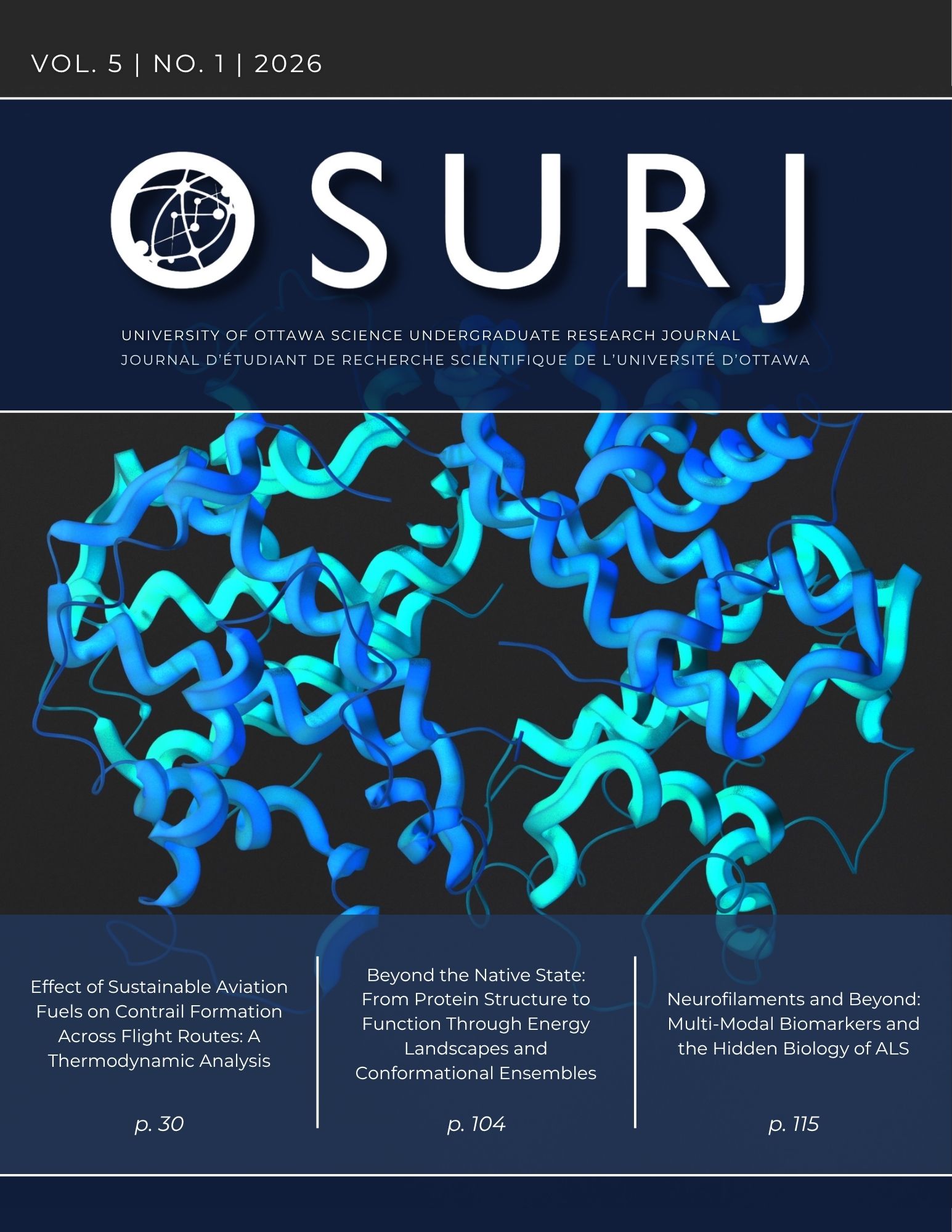
Beyond the Native State: From Protein Structure to Function Through Energy Landscapes and Conformational Ensembles
DOI:
https://doi.org/10.18192/osurj.v5i1.8045Abstract
Rather than viewing protein folding as the formation of a single native structure, modern biophysics describes proteins as statistical ensembles of interconverting conformations whose populations are determined by thermodynamics, kinetics, and the energy landscape imposed by molecular interactions. Within this framework, folding is not considered a discrete event, but a dynamic process. When placed in a cellular context, these dynamic conformational ensembles are coupled to protein function and are directly influenced by the intracellular environment and interacting proteins. Protein folding and function still follow biophysical laws, albeit with varying significances, and can be described using kinetic models of intra- and intermolecular interactions. This review explores the biophysical, biochemical, and cellular determinants of protein folding, specifically highlighting that protein behaviour is a property of ensemble dynamics and the intracellular environment.
Downloads
Published
Issue
Section
License
OSURJ Publication Rights Policy Agreement
Please fill in the following blanks.
I, ____________________ (submitting author) am submitting an article to the University of Ottawa Science Undergraduate Research Journal (OSURJ) entitled _________________________________________________________________________
- OSURJ Mandate:
The University of Ottawa Science Undergraduate Research Journal is a bilingual multidisciplinary open-access and non-proprietary journal. A journal of this nature embraces all disciplines of science and is the result of a collaborative effort between undergraduate, graduate, and faculty members. Our goal is to provide invaluable publishing and submission process experience to undergraduate students and ultimately to promote undergraduate research within the uOttawa community.
- Review Process of OSURJ
OSURJ uses a double-blind review process. The submitted article is first reviewed by the Editor-in-Chief(s) to confirm whether the submission is within the scope of OSURJ. After which, it is sent to the managing editor(s) who assign the article to the relevant undergraduate associate reviewer and graduate or faculty reviewer for independent review. The reviewers recommend to either reject, accept, or conditionally accept the article with revisions required. Based on the recommendations from both reviewers, the Co-Editor-in-Chief(s) make(s) the final decision regarding publication.
III. Proprietorship and Author Rights:
Authors retain all copyrights to their research and original data and may publish in other journals at the journal’s discretion. OSURJ acknowledges that all information submitted by the author(s) is their intellectual property and therefore any republication of such property is not allowed without written consent from the submitting author(s). Articles published in OSURJ may be published in other journals. However, authors should be made aware that other publishers may not permit the republication of original research published in an undergraduate journal such as OSURJ. Consequently, the author should consult the publication policies of other journals, and all relevant parties should be made aware of this possibility before proceeding with article submission.
- Falsification of Data:
Methods for the acquisition and analysis of data should be accurately and fully displayed to allow for replication by other researchers. Data fabrication and alteration is unethical and may lead to unfounded conclusions. As such, it is not permitted by OSURJ.
- Statement of Originality
The author(s) confirms that their submission, including all content, phrases, graphics and figures are their own. The article demonstrates the author’s own work and skill. The author is aware that plagiarism (the use of someone else's work without their permission and/or without acknowledging the original source) is wrong. They confirm that ALL the work submitted for consideration is their own work and confirms to explicitly indicate and source outside material. The author recognizes that failure to comply with academic integrity could result in disqualification from the journal or other measures.
- Permission from All Contributors:
- Given that research is collaboratively conducted with professors and other students, OSURJ requires that all contributors (co-authors, primary investigators, lab managers, supervisors) consent to the submission of the article to OSURJ.
- Any person listed as an author of an article must have contributed greatly to the data, analysis or interpretation of said data and should provide approval of the submitted version. It is unethical to not list those who contributed to the standards of an author and to include those who do not meet the criteria for authorship.
- For articles with multiple authors, primary, secondary (etc.) author status must also be agreed upon. As the submitting author, you must declare that you have read this publication agreement and grant your permission for OSURJ to publish the submitted article. You must also declare that all contributors with claims to this intellectual property have read this agreement and have signed below.
VII. Conflict of Interest Disclosure:
Authors must disclose any financial, academic, or personal relationships that could be perceived to influence the research or its interpretation. If no conflicts exist, authors must state: “The authors declare no conflicts of interest.”
____________________________________________________________
VIII. Research Ethics Compliance
Authors must confirm that any research involving human participants, animals, or sensitive data received appropriate institutional ethics approval and was conducted in accordance with relevant guidelines. Documentation may be requested by OSURJ.
- Use of AI Tools
Authors must disclose any use of generative AI tools in writing, data analysis, or figure preparation. AI tools may not be listed as authors and must not be used to generate falsified data or citations.
As the submitting author, I hereby declare that I have read this publication agreement and grant my permission for OSURJ to publish the submitted article. I also declare that all contributors with claims to this intellectual property have read this agreement and have signed below.
Signed,
______________________________ _______________________________ ________
Name of submitting Author Signature Date
As a contributing investigator/supervisor/author, I hereby declare that I have read this publication agreement and grant my permission for OSURJ to publish the submitted article. I also declare that I understand that re-publication of this article after publication in this journal, while permitted by OSURJ, might not be permitted by other scholarly journals.
Signed,
______________________________ _______________________________ ________
Name (indicate role) Signature Date
______________________________ _______________________________ ________
Name (indicate role) Signature Date
______________________________ _______________________________ ________
Name (indicate role) Signature Date
______________________________ _______________________________ ________
Name (indicate role) Signature Date
______________________________ _______________________________ ________
Name (indicate role) Signature Date
