
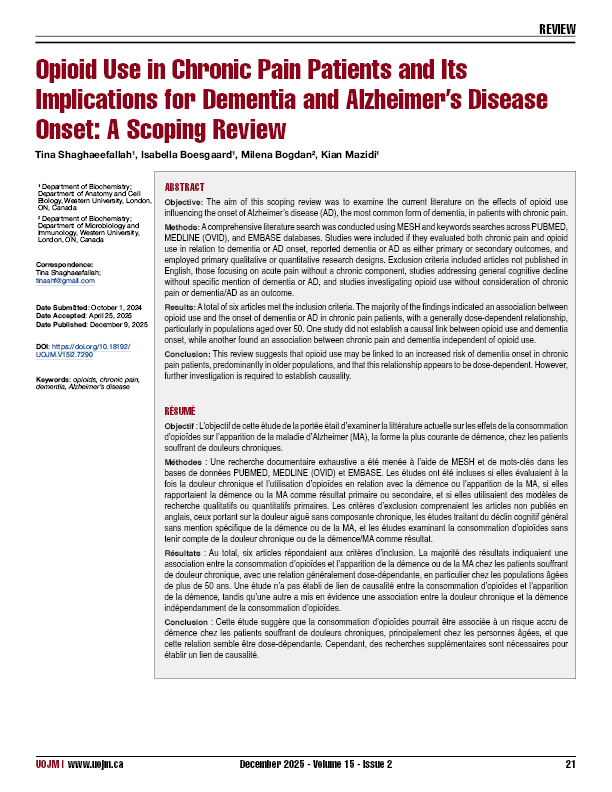
Opioid Use in Chronic Pain Patients and Its Implications for Dementia and Alzheimer’s Disease Onset: A Scoping Review
DOI:
https://doi.org/10.18192/uojm.v15i2.7290Keywords:
dementia, Alzheimer’s disease, chronic pain, opioidAbstract
Objective: The aim of this narrative review was to examine the current literature on the effects of opioid use regarding the onset of dementia and Alzheimer’s disease (AD) in patients with chronic pain.
Method: A comprehensive literature search was conducted using MESH and keywords searches across PUBMED, MEDLINE (OVID), and EMBASE databases. Studies were included if they evaluated both chronic pain and opioid use in relation to dementia or AD onset, reported dementia or AD as either primary or secondary outcomes, and employed primary qualitative or quantitative research designs. Exclusion criteria included articles not published in English, those focusing on acute pain without a chronic component, studies addressing general cognitive decline without specific mention of dementia or AD, and studies investigating opioid use without consideration of chronic pain or dementia/AD as an outcome.
Results: A total of six articles met the inclusion criteria. Most of the findings indicated an association between opioid use and the onset of dementia or AD in chronic pain patients, with a predominantly dose-dependent relationship, particularly in populations aged over 50. One study did not establish a causal link between opioid use and dementia onset, while another found an association between chronic pain and dementia independent of opioid use.
Conclusion: This review suggests that opioid use may be linked to an increased risk of dementia onset in chronic pain patients, predominantly in older populations, and that this relationship appears to be dose-dependent. However, further investigation is required to establish causality
----------
Objectif : L’objectif de cette étude de la portée était d’examiner la littérature actuelle sur les effets de la consommation d’opioïdes sur l’apparition de la maladie d’Alzheimer (MA), la forme la plus courante de démence, chez les patients souffrant de douleurs chroniques.
Méthodes : Une recherche documentaire exhaustive a été menée à l’aide de MESH et de mots-clés dans les bases de données PUBMED, MEDLINE (OVID) et EMBASE. Les études ont été incluses si elles évaluaient à la fois la douleur chronique et l’utilisation d’opioïdes en relation avec la démence ou l’apparition de la MA, si elles rapportaient la démence ou la MA comme résultat primaire ou secondaire, et si elles utilisaient des modèles de recherche qualitatifs ou quantitatifs primaires. Les critères d’exclusion comprenaient les articles non publiés en anglais, ceux portant sur la douleur aiguë sans composante chronique, les études traitant du déclin cognitif général sans mention spécifique de la démence ou de la MA, et les études examinant la consommation d’opioïdes sans tenir compte de la douleur chronique ou de la démence/MA comme résultat.
Résultats : Au total, six articles répondaient aux critères d’inclusion. La majorité des résultats indiquaient une association entre la consommation d’opioïdes et l’apparition de la démence ou de la MA chez les patients souffrant de douleur chronique, avec une relation généralement dose-dépendante, en particulier chez les populations âgées de plus de 50 ans. Une étude n’a pas établi de lien de causalité entre la consommation d’opioïdes et l’apparition de la démence, tandis qu’une autre a mis en évidence une association entre la douleur chronique et la démence indépendamment de la consommation d’opioïdes.
Conclusion : Cette étude suggère que la consommation d’opioïdes pourrait être associée à un risque accru de démence chez les patients souffrant de douleurs chroniques, principalement chez les personnes âgées, et que cette relation semble être dose-dépendante. Cependant, des recherches supplémentaires sont nécessaires pour établir un lien de causalité.
References
Dydyk AM, Conermann T. Chronic Pain [Internet]. Available from: https://www.ncbi.nlm.nih.gov/books/NBK553030/
Goldberg DS, McGee SJ. Pain as a global public health priority. BMC Public Health. 2011 Dec;11(1):770.
Wang Z, Sun Z, Zheng H. Association between chronic pain and dementia: a systematic review and meta-analysis. Eur J Ageing. 2024 Dec;21(1):17.
Tian J, Jones G, Lin X, Zhou Y, King A, Vickers J, et al. Association between chronic pain and risk of incident dementia: findings from a prospective cohort. BMC Med. 2023 May 4;21(1):169.
Rouch I, Edjolo A, Laurent B, Dartigues J, Amieva H. Chronic pain and long‐term dementia risk in older adults: Results from a 24‐year longitudinal study. Int J Geriat Psychiatry. 2022 May;37(5):gps.5713.
Philipps J, Ford M, Bonnie R. Pain Management and the Opioid Epidemic: Balancing Societal and Individual Benefits and Risks of Prescription Opioid Use. [Internet]. 2017. Available from: https://www.ncbi.nlm.nih.gov/books/NBK458655/
Levine SZ, Rotstein A, Goldberg Y, Reichenberg A, Kodesh A. Opioid Exposure and the Risk of Dementia: A National Cohort Study. The American Journal of Geriatric Psychiatry. 2023 May;31(5):315–23.
Taipale H, Hamina A, Lampela P, Tanskanen A, Tiihonen J, Karttunen N, et al. Is Alzheimer’s Disease Associated with Previous Opioid Use? Pain Medicine. 2018 Nov 1;19(11):2115–21.
Arksey H, O’Malley L. Scoping studies: towards a methodological framework. International Journal of Social Research Methodology. 2005 Feb;8(1):19–32.
Khalid S., Sambamoorthi U., Innes K.E. Non-cancer chronic pain conditions and risk for incident alzheimer’s disease and related dementias in community-dwelling older adults: A population-based retrospective cohort study of united states medicare beneficiaries, 2001-2013. Int J Environ Res Public Health. 2020;17(15):1–19.
Gao Y, Su B, Ding L, Qureshi D, Hong S, Wei J, et al. Association of Regular Opioid Use With Incident Dementia and Neuroimaging Markers of Brain Health in Chronic Pain Patients: Analysis of UK Biobank. Am J Geriatr Psychiatry. 2024 Sep;32(9):1154–65.
Bornier N., Mulliez A., Chenaf C., Elyn A., Teixeira S., Authier N., et al. Chronic pain is a risk factor for incident Alzheimer’s disease: a nationwide propensity-matched cohort using administrative data. Front Aging Neurosci. 2023;15((Bornier, Mulliez, Chenaf, Teixeira, Authier, Bertin, Kerckhove) Department of Agricultural Statistics, Uttar Banga Krishi Viswavidyalaya, West Bengal, Cooch Behar, India):1193108.
Guo X, Hou C, Tang P, Li R. Chronic Pain, Analgesics, and Cognitive Status: A Comprehensive Mendelian Randomization Study. Anesth Analg. 2023 Oct 1;137(4):896–905.
Oh TK, Song IA. Impact of prescribed opioid use on development of dementia among patients with chronic non-cancer pain. Sci Rep. 2024 Feb 9;14(1):3313.
Sun M, Chen WM, Wu SY, Zhang J. Long-Term Opioid Use and Dementia Risk in Patients With Chronic Pain. J Am Med Dir Assoc. 2023 Sep;24(9):1420-1426.e2.
Schuff N, Woerner N, Boreta L, Kornfield T, Shaw LM, Trojanowski JQ, et al. MRI of hippocampal volume loss in early Alzheimer’s disease in relation to ApoE genotype and biomarkers. Brain. 2009 Apr;132(4):1067–77.
Dawe RJ, Yu L, Arfanakis K, Schneider JA, Bennett DA, Boyle PA. Late-life cognitive decline is associated with hippocampal volume, above and beyond its associations with traditional neuropathologic indices. Alzheimer’s & Dementia. 2020;16(1):209–18.
Neelamegam M, Zgibor J, Chen H, O’rourke K, Bakour C, Rajaram L, et al. The effect of opioids on the cognitive function of older adults: results from the Personality and Total Health through life study. Age and Ageing. 2021 Sep 11;50(5):1699–708.
Dublin S, Walker RL, Gray SL, Hubbard RA, Anderson ML, Yu O, et al. Prescription Opioids and Risk of Dementia or Cognitive Decline: A Prospective Cohort Study. J American Geriatrics Society. 2015 Aug;63(8):1519–26.
Cai Z, Ratka A. Opioid System and Alzheimer’s Disease. Neuromol Med. 2012 Jun;14(2):91–111.
Tanguturi P, Streicher JM. The role of opioid receptors in modulating Alzheimer’s Disease. Front Pharmacol. 2023 Mar 1;14:1056402.
Upadhyay J, Maleki N, Potter J, Elman I, Rudrauf D, Knudsen J, et al. Alterations in brain structure and functional connectivity in prescription opioid-dependent patients. Brain. 2010 Jul 1;133(7):2098–114.
Kamboj SK, Conroy L, Tookman A, Carroll E, Jones L, Curran HV. Effects of immediate‐release opioid on memory functioning: a randomized‐controlled study in patients receiving sustained‐release opioids. European Journal of Pain. 2014 Nov;18(10):1376–84.
Kao PH, Jang FL, Ho CH, Chen YC, Hsu CC, Lin HJ, et al. Chronic Pain Increases the Risk of Dementia: A Nationwide Population-Based Cohort Study. 2021;(24):849–56.
Innes KE, Sambamoorthi U. The Association of Osteoarthritis and Related Pain Burden to Incident Alzheimer’s Disease and Related Dementias: A Retrospective Cohort Study of U.S. Medicare Beneficiaries. JAD. 2020 Jun 2;75(3):789–805.
Khalid S, Sambamoorthi U, Umer A, Lilly CL, Gross DK, Innes KE. Increased Odds of Incident Alzheimer’s Disease and Related Dementias in Presence of Common Non-Cancer Chronic Pain Conditions in Appalachian Older Adults. J Aging Health. 2022 Mar;34(2):158–
Ezzati A, Wang C, Katz MJ, Derby CA, Zammit AR, Zimmerman ME, et al. The Temporal Relationship between Pain Intensity and Pain Interference and Incident Dementia. CAR. 2019 Feb 4;16(2):109–15.
Downloads
Published
How to Cite
Issue
Section
License
Copyright (c) 2025 Tina Shaghaeefallah, Isabella Boesgaard, Milena Bogdan, Kian Mazidi

This work is licensed under a Creative Commons Attribution-NonCommercial-NoDerivatives 4.0 International License.
- Authors publishing in the UOJM retain copyright of their articles, including all the drafts and the final published version in the journal.
- While UOJM does not retain any rights to the articles submitted, by agreeing to publish in UOJM, authors are granting the journal right of first publication and distribution rights of their articles.
- Authors are free to submit their works to other publications, including journals, institutional repositories or books, with an acknowledgment of its initial publication in UOJM.
- Copies of UOJM are distributed both in print and online, and all materials will be publicly available online. The journal holds no legal responsibility as to how these materials will be used by the public.
- Please ensure that all authors, co-authors and investigators have read and agree to these terms.
- Works are licensed under a Creative Commons Attribution-NonCommercial-NoDerivatives 4.0 International License.
