
Factors Associated with Vaccine Hesitancy Among Adults in Peshawar, Khyber Pakhtunkhwa, Pakistan: A Cross-Sectional Study
DOI:
https://doi.org/10.18192/uojm.v15i2.7366Keywords:
Vaccine Hesitancy, Socio-Demographic Factors, Healthcare Worker Influence Peshawar, PakistanAbstract
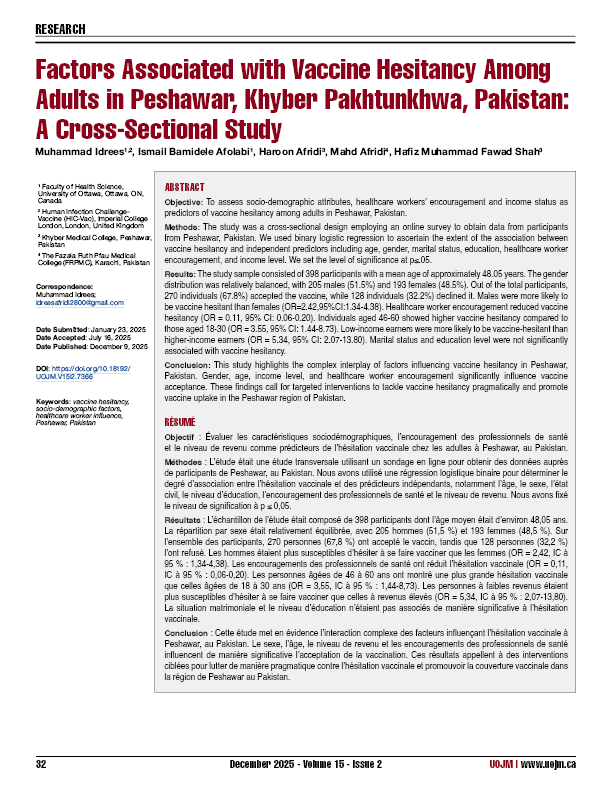
Objective: To assess socio-demographic attributes, healthcare workers' encouragement, and income status as predictors of vaccine hesitancy among adults in Peshawar, Pakistan.
Methods: The study was a cross-sectional design employing an online survey to obtain data from participants from Peshawar, Pakistan. We used binary logistic regression to ascertain the extent of the association between vaccine hesitancy and independent predictors including age, gender, marital status, education, healthcare worker encouragement, and income level. We set the level of significance at p≤.05.
Results: The study sample consisted of 398 participants with a mean age of approximately 48.05 years. The gender distribution was relatively balanced, with 205 males (51.5%) and 193 females (48.5%). Out of the total participants, 270 individuals (67.8%) accepted the vaccine, while 128 individuals (32.2%) declined it. Males were more likely to be vaccine hesitant than females (OR=2.42,95%CI:1.34-4.38). Healthcare worker encouragement reduced vaccine hesitancy (OR = 0.11, 95% CI: 0.06-0.20). Individuals aged 46-60 showed higher vaccine hesitancy compared to those aged 18-30 (OR = 3.55, 95% CI: 1.44-8.73). Low-income earners were more likely to be vaccine-hesitant than higher-income earners (OR = 5.34, 95% CI: 2.07-13.80). Marital status and education level were not significantly associated with vaccine hesitancy.
Conclusion: The study highlights the complex interplay of factors influencing vaccine hesitancy in Peshawar, Pakistan. Gender, age, income level, and healthcare worker encouragement significantly influence vaccine acceptance. These findings call for targeted interventions to tackle vaccine hesitancy pragmatically and promote vaccine uptake in the Peshawar region of Pakistan.
----------
Objectif : Évaluer les caractéristiques sociodémographiques, l’encouragement des professionnels de santé et le niveau de revenu comme prédicteurs de l’hésitation vaccinale chez les adultes à Peshawar, au Pakistan.
Méthodes : L’étude était une étude transversale utilisant un sondage en ligne pour obtenir des données auprès de participants de Peshawar, au Pakistan. Nous avons utilisé une régression logistique binaire pour déterminer le degré d’association entre l’hésitation vaccinale et des prédicteurs indépendants, notamment l’âge, le sexe, l’état civil, le niveau d’éducation, l’encouragement des professionnels de santé et le niveau de revenu. Nous avons fixé le niveau de signification à p ≤ 0,05.
Résultats : L’échantillon de l’étude était composé de 398 participants dont l’âge moyen était d’environ 48,05 ans. La répartition par sexe était relativement équilibrée, avec 205 hommes (51,5 %) et 193 femmes (48,5 %). Sur l’ensemble des participants, 270 personnes (67,8 %) ont accepté le vaccin, tandis que 128 personnes (32,2 %) l’ont refusé. Les hommes étaient plus susceptibles d’hésiter à se faire vacciner que les femmes (OR = 2,42, IC à 95 % : 1,34-4,38). Les encouragements des professionnels de santé ont réduit l’hésitation vaccinale (OR = 0,11, IC à 95 % : 0,06-0,20). Les personnes âgées de 46 à 60 ans ont montré une plus grande hésitation vaccinale que celles âgées de 18 à 30 ans (OR = 3,55, IC à 95 % : 1,44-8,73). Les personnes à faibles revenus étaient plus susceptibles d’hésiter à se faire vacciner que celles à revenus élevés (OR = 5,34, IC à 95 % : 2,07-13,80). La situation matrimoniale et le niveau d’éducation n’étaient pas associés de manière significative à l’hésitation vaccinale.
Conclusion : Cette étude met en évidence l’interaction complexe des facteurs influençant l’hésitation vaccinale à Peshawar, au Pakistan. Le sexe, l’âge, le niveau de revenu et les encouragements des professionnels de santé influencent de manière significative l’acceptation de la vaccination. Ces résultats appellent à des interventions ciblées pour lutter de manière pragmatique contre l’hésitation vaccinale et promouvoir la couverture vaccinale dans la région de Peshawar au Pakistan.
References
1. WHO. Ten threats to global health in 2019. 2019 [Internet]. 2019; Available from: https://www.who.int/news-room/spotlight/ten-threats-to-global-health-in-2019
2. MacDonald NE. Vaccine hesitancy: Definition, scope and determinants. Vaccine. 2015 Aug 14;33(34):4161–4164.
3. Polio vaccination controversy in Pakistan - PubMed [Internet]. [cited 2025 Mar 9]. Available from: https://pubmed.ncbi.nlm.nih.gov/31526731/
4. Khan YH, Mallhi TH, Alotaibi NH, Alzarea AI, Alanazi AS, Tanveer N, Hashmi FK. Threat of COVID-19 Vaccine Hesitancy in Pakistan: The Need for Measures to Neutralize Misleading Narratives. Am J Trop Med Hyg. 2020 Aug;103(2):603–604. PMCID: PMC7410483
5. Sheikh NS, Touseef M, Sultan R, Cheema KH, Cheema SS, Sarwar A, Siddique HZ. Understanding COVID-19 vaccine hesitancy in Pakistan: The paradigm of confidence, convenience, and complacency; A cross-sectional study. PloS One. 2023;18(8):e0289678. PMCID: PMC10431607
6. Syan SK, Gohari MR, Levitt EE, Belisario K, Gillard J, DeJesus J, MacKillop J. COVID-19 Vaccine Perceptions and Differences by Sex, Age, and Education in 1,367 Community Adults in Ontario. Front Public Health. 2021 Sep 22;9:719665. PMCID: PMC8494003
7. Ishimaru T, Okawara M, Ando H, Hino A, Nagata T, Tateishi S, Tsuji M, Matsuda S, Fujino Y. Gender differences in the determinants of willingness to get the COVID-19 vaccine among the working-age population in Japan. Hum Vaccines Immunother. 2021;17(11):3975–3981. PMCID: PMC8827630
8. Ali S, Sophie R, Imam AM, Khan FI, Ali SF, Shaikh A, Farid-ul-Hasnain S. Knowledge, perceptions and myths regarding infertility among selected adult population in Pakistan: a cross-sectional study. BMC Public Health. 2011 Oct 4;11(1):760.
9. Kyla Thomas, Jill Darling, Alwyn Cassil. COVID-19 Vaccine Hesitancy: Education Divide Widens. USC Dornsife Cent Econ Soc Res – Underst Coronavirus Am Track Study Wave 23 Early Febr 2021 [Internet]. 2021; Available from: https://healthpolicy.usc.edu/evidence-base/education-is-now-a-bigger-factor-than-race-in-desire-for-covid-19-vaccine/
10. Liu H, Nowak GR, Wang J, Luo Z. A National Study of Marital Status Differences in Early Uptake of COVID-19 Vaccine among Older Americans. Geriatrics. 2023 Jun 28;8(4):69. PMCID: PMC10366868
11. Gerretsen P, Kim J, Caravaggio F, Quilty L, Sanches M, Wells S, Brown EE, Agic B, Pollock BG, Graff-Guerrero A. Individual determinants of COVID-19 vaccine hesitancy. PLOS ONE. Public Library of Science; 2021 Nov 17;16(11):e0258462.
12. Muhajarine N, Adeyinka DA, McCutcheon J, Green KL, Fahlman M, Kallio N. COVID-19 vaccine hesitancy and refusal and associated factors in an adult population in Saskatchewan, Canada: Evidence from predictive modelling. PLOS ONE. Public Library of Science; 2021 Nov 12;16(11):e0259513.
13. Vlasak D, Dinero RE, Roitman NA. Vaccine hesitancy at both ends of the socioeconomic spectrum: a new paradigm for understanding the role of systemic inequity. J Public Health Emerg [Internet]. AME Publishing Company; 2023 Dec 25 [cited 2024 Dec 27];7(0). Available from: https://jphe.amegroups.org/article/view/9493
14. Kim B, Hong S, Kim S. Are they still determining? Analysis of associations among ethnicity, gender, socioeconomic status, neighborhood factors, and COVID-19 vaccination. Front Commun [Internet]. Frontiers; 2023 Apr 4 [cited 2024 Dec 27];8. Available from: https://www.frontiersin.org/journals/communication/articles/10.3389/fcomm.2023.1040797/full
15. Mehmood Q, Ullah I, Hasan MM, Kazmi SK, Ahmadi A, Lucero-Prisno DE. COVID-19 vaccine hesitancy: Pakistan struggles to vaccinate its way out of the pandemic. Ther Adv Vaccines Immunother. 2022 Feb 10;10:25151355221077658. PMCID: PMC8841903
16. Lip A, Pateman M, Fullerton MM, Chen HM, Bailey L, Houle S, Davidson S, Constantinescu C. Vaccine hesitancy educational tools for healthcare providers and trainees: A scoping review. Vaccine. 2023 Jan 4;41(1):23–35. PMCID: PMC9688224
17. Goje O, Kapoor A. Meeting the challenge of vaccine hesitancy. Cleve Clin J Med. Cleveland Clinic Journal of Medicine; 2024 Sep 1;91(9 suppl 1):S50–S56. PMID: 39231603
18. Opel DJ, Mangione-Smith R, Robinson JD, Heritage J, DeVere V, Salas HS, Zhou C, Taylor JA. The Influence of Provider Communication Behaviors on Parental Vaccine Acceptance and Visit Experience. Am J Public Health. American Public Health Association; 2015 Oct;105(10):1998–2004.
19. Malik A, Malik J, Ishaq U. Acceptance of COVID-19 vaccine in Pakistan among health care workers. PLOS ONE. Public Library of Science; 2021 Sep 15;16(9):e0257237.
20. Wahid B, Kumari B, Saifullah KM, Idrees M. The History and Current Killings of Polio Vaccinators in Pakistan: A Need for Targeted Surveillance Strategy. Asia Pac J Public Health. 2023 Mar;35(2–3):183–188. PMCID: PMC10185917
21. Khan AA, Abdullah M, Aliani R, Mohiuddin AF, Sultan F. COVID-19 vaccine hesitancy and attitudes in Pakistan: a cross-sectional phone survey of major urban cities. BMC Public Health. 2023 Jun 9;23(1):1112.
22. Larson HJ, Cooper LZ, Eskola J, Katz SL, Ratzan S. Addressing the vaccine confidence gap. Lancet Lond Engl. 2011 Aug 6;378(9790):526–535. PMID: 21664679
23. Yamane T. T. Yamane Statistics: an introductory analysis (second ed.), Harper and Row, New York (1967). 1967; Available from: https://scholar.google.com/scholar_lookup?title=Statistics%3A%20an%20introductory%20analysis&publication_year=1967&author=T.%20Yamane
24. Wahid B, Kumari B, Saifullah KM, Idrees M. The History and Current Killings of Polio Vaccinators in Pakistan: A Need for Targeted Surveillance Strategy. Asia Pac J Public Health. 2023 Mar;35(2–3):183–188. PMCID: PMC10185917
25. The Jamovi Project. The jamovi project (2022). jamovi. (Version 2.3) [Computer Software]. Retrieved from https://www.jamovi.org. [Internet]. JAMOVI Org; 2022. Available from: https://www.jamovi.org.
26. Lazarus JV, Ratzan SC, Palayew A, Gostin LO, Larson HJ, Rabin K, Kimball S, El-Mohandes A. A global survey of potential acceptance of a COVID-19 vaccine. Nat Med. 2021 Feb;27(2):225–228. PMCID: PMC7573523
27. Solís Arce JS, Warren SS, Meriggi NF, Scacco A, McMurry N, Voors M, et al. COVID-19 vaccine acceptance and hesitancy in low- and middle-income countries. Nat Med. 2021;27(8):1385–1394. PMCID: PMC8363502
28. Ali TS, Krantz G, Gul R, Asad N, Johansson E, Mogren I. Gender roles and their influence on life prospects for women in urban Karachi, Pakistan: a qualitative study. Glob Health Action. 2011 Nov 2;4:10.3402/gha.v4i0.7448. PMCID: PMC3208374
29. Nindrea RD, Usman E, Katar Y, Sari NP. Acceptance of COVID-19 vaccination and correlated variables among global populations: A systematic review and meta-analysis. Clin Epidemiol Glob Health. 2021;12:100899. PMCID: PMC8559452
30. Khan W, Khan J, Gul A, Naz A. Masculinity and family violence: an investigation into the Pakhtuns’ violent masculinities in parental & spousal relations. 2022 Mar 15 [cited 2025 Jan 3]; Available from: https://zenodo.org/records/7627699
31. Wang Y, Liu Y. Multilevel determinants of COVID-19 vaccination hesitancy in the United States: A rapid systematic review. Prev Med Rep. 2022 Feb 1;25:101673.
32. Lupu D, Tiganasu R. Does education influence COVID-19 vaccination? A global view. Heliyon. 2024 Jan 19;10(3):e24709. PMCID: PMC10837567
33. Greyson D, Bettinger JA. How do mothers’ vaccine attitudes change over time? SSM - Qual Res Health. 2022 Dec 1;2:100060.
34. Malik AA, McFadden SM, Elharake J, Omer SB. Determinants of COVID-19 vaccine acceptance in the US. EClinicalMedicine. 2020 Sep;26:100495. PMCID: PMC7423333
35. Borga LG, Clark AE, D’Ambrosio C, Lepinteur A. Characteristics associated with COVID-19 vaccine hesitancy. Sci Rep. Nature Publishing Group; 2022 Jul 20;12(1):12435.
36. Government of Canada SC. Sociodemographic disparities in COVID-19 vaccine uptake and vaccination intent in Canada [Internet]. 2022 [cited 2025 Jan 3]. Available from: https://www150.statcan.gc.ca/n1/pub/82-003-x/2022012/article/00004-eng.htm
Downloads
Published
How to Cite
Issue
Section
License
Copyright (c) 2025 Muhammad Idrees, Ismail Bamidele Afolabi, Haroon Afridi, Mahd Afridi, Hafiz Muhammad Fawad Shah

This work is licensed under a Creative Commons Attribution-NonCommercial-NoDerivatives 4.0 International License.
- Authors publishing in the UOJM retain copyright of their articles, including all the drafts and the final published version in the journal.
- While UOJM does not retain any rights to the articles submitted, by agreeing to publish in UOJM, authors are granting the journal right of first publication and distribution rights of their articles.
- Authors are free to submit their works to other publications, including journals, institutional repositories or books, with an acknowledgment of its initial publication in UOJM.
- Copies of UOJM are distributed both in print and online, and all materials will be publicly available online. The journal holds no legal responsibility as to how these materials will be used by the public.
- Please ensure that all authors, co-authors and investigators have read and agree to these terms.
- Works are licensed under a Creative Commons Attribution-NonCommercial-NoDerivatives 4.0 International License.
