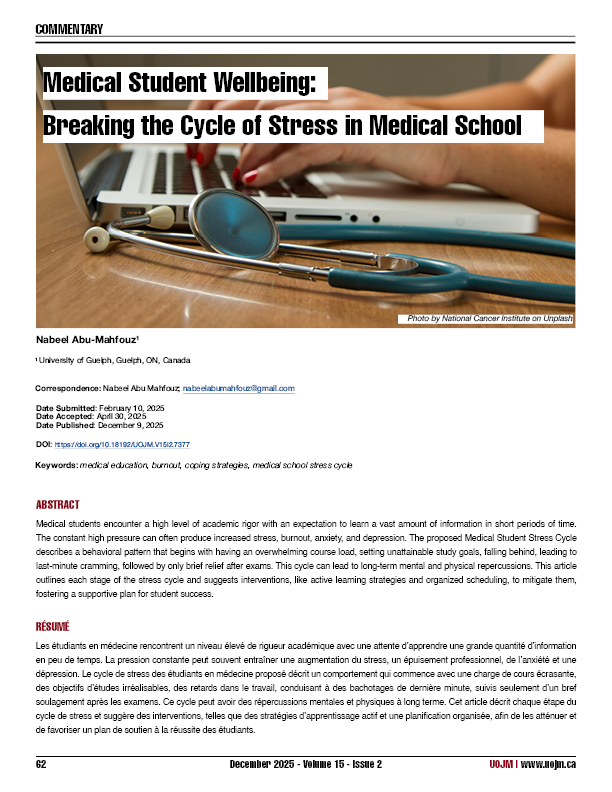
Medical Student Wellbeing: Breaking the Cycle of Stress in Medical School
DOI:
https://doi.org/10.18192/uojm.v15i2.7377Keywords:
medical education, burnout, coping strategies, medical school stress cycleAbstract
Medical students encounter a high level of academic rigor with an expectation to learn a vast amount of information in short periods of time. The proposed Medical Student Stress Cycle describes a behavioral pattern which begins with having an overwhelming course load, setting unattainable study goals, falling behind, leading to last-minute cramming, followed by only brief relief after exams. This cycle can lead to long-term mental and physical repercussions. This article outlines each stage of the stress cycle and suggests interventions, like active learning strategies and organized scheduling, to mitigate them, fostering a supportive plan for student success.
----------
Les étudiants en médecine rencontrent un niveau élevé de rigueur académique avec une attente d’apprendre une grande quantité d’information en peu de temps. La pression constante peut souvent entraîner une augmentation du stress, un épuisement professionnel, de l’anxiété et une dépression. Le cycle de stress des étudiants en médecine proposé décrit un comportement qui commence avec une charge de cours écrasante, des objectifs d’études irréalisables, des retards dans le travail, conduisant à des bachotages de dernière minute, suivis seulement d’un bref soulagement après les examens. Ce cycle peut avoir des répercussions mentales et physiques à long terme. Cet article décrit chaque étape du cycle de stress et suggère des interventions, telles que des stratégies d’apprentissage actif et une planification organisée, afin de les atténuer et de favoriser un plan de soutien à la réussite des étudiants.
References
Almutairi H, Alsubaiei A, Abduljawad S, Alshatti A, Fekih-Romdhane F, Husni M, Jahrami H. Prevalence of burnout in medical students: A systematic review and meta-analysis. Int J Soc Psychiatry. 2022 Sep;68(6):1157–1170. PMID: 35775726
Feenstra S, Begeny CT, Ryan MK, Rink FA, Stoker JI, Jordan J. Contextualizing the Impostor “Syndrome.” Front Psychol. 2020 Nov 13;11:575024. PMCID: PMC7703426
Bravata DM, Watts SA, Keefer AL, Madhusudhan DK, Taylor KT, Clark DM, Nelson RS, Cokley KO, Hagg HK. Prevalence, Predictors, and Treatment of Impostor Syndrome: a Systematic Review. J Gen Intern Med. 2020 Apr;35(4):1252–1275. PMCID: PMC7174434
Niroula S, Niroula A. Effective Way of Studying and Learning in Medical School. JNMA J Nepal Med Assoc. 2020 Nov;58(231):954–956. PMCID: PMC7775017
Torre D, German D, Daley B, Taylor D. Concept mapping: An aid to teaching and learning: AMEE Guide No. 157. Med Teach. 2023 May;45(5):455–463. PMID: 36862077
Densen P. Challenges and Opportunities Facing Medical Education. Trans Am Clin Climatol Assoc. 2011;122:48–58. PMCID: PMC3116346
Fernández-García O, Gil-Llario MD, Castro-Calvo J, Morell-Mengual V, Ballester-Arnal R, Estruch-García V. Academic Perfectionism, Psychological Well-Being, and Suicidal Ideation in College Students. Int J Environ Res Public Health. 2022 Dec 21;20(1):85. PMCID: PMC9819691
Burnout in early year medical students: experiences, drivers and the perceived value of a reflection-based intervention - PMC [Internet]. [cited 2025 Feb 7]. Available from: https://pmc.ncbi.nlm.nih.gov/articles/PMC10765935/
Bjerke MB, Renger R. Being smart about writing SMART objectives. Eval Program Plann. 2017 Apr;61:125–127. PMID: 28056403
Biwer F, Wiradhany W, Oude Egbrink MGA, de Bruin ABH. Understanding effort regulation: Comparing “Pomodoro” breaks and self-regulated breaks. Br J Educ Psychol. 2023 Aug;93 Suppl 2:353–367. PMID: 36859717
Wrench A, Padilla M, O’Malley C, Levy A. Impostor phenomenon: Prevalence among 1st year medical students and strategies for mitigation. Heliyon. 2024 Apr 9;10(8):e29478. PMCID: PMC11019193
Ogunyemi D, Lee T, Ma M, Osuma A, Eghbali M, Bouri N. Improving wellness: Defeating Impostor syndrome in medical education using an interactive reflective workshop. PLoS One. 2022;17(8):e0272496. PMCID: PMC9352101
Khan MA, Al-Jahdali H. The consequences of sleep deprivation on cognitive performance. Neurosciences (Riyadh). 2023 Apr;28(2):91–99. PMCID: PMC10155483
Córdova A, Caballero-García A, Drobnic F, Roche E, Noriega DC. Influence of Stress and Emotions in the Learning Process: The Example of COVID-19 on University Students: A Narrative Review. Healthcare (Basel). 2023 Jun 17;11(12):1787. PMCID: PMC10298416
Michael K, Schujovitzky D, Karnieli-Miller O. The associations between resilience, self-care, and burnout among medical students. PLoS One. 2024;19(9):e0309994. PMCID: PMC11412677
Van Hoof TJ, Sumeracki MA, Madan CR. Science of Learning Strategy Series: Article 3, Interleaving. J Contin Educ Health Prof. 2022 Oct 1;42(4):265–268. PMID: 35170479
Puri S, Shaheen M, Grover B. Nutrition and cognitive health: A life course approach. Front Public Health. 2023 Mar 27;11:1023907. PMCID: PMC10083484
Study shows how taking short breaks may help our brains learn new skills [Internet]. National Institutes of Health (NIH). 2021 [cited 2025 Feb 7]. Available from: https://www.nih.gov/news-events/news-releases/study-shows-how-taking-short-breaks-may-help-our-brains-learn-new-skills
Li CJ, Shah YB, Harness ED, Goldberg ZN, Nash DB. Physician Burnout and Medical Errors: Exploring the Relationship, Cost, and Solutions. Am J Med Qual. 2023 Aug 1;38(4):196–202. PMID: 37382306
Yang Q, Liu Y, Yang WF, Peng P, Chen S, Wang Y, Wang X, Li M, Wang Y, Hao Y, He L, Wang Q, Zhang J, Ma Y, He H, Zhou Y, Long J, Qi C, Tang YY, Liao Y, Tang J, Wu Q, Liu T. Mental health conditions and academic burnout among medical and non-medical undergraduates during the mitigation of COVID-19 pandemic in China. Environ Sci Pollut Res Int. 2022;29(38):57851–57859. PMCID: PMC8969817
Mahindru A, Patil P, Agrawal V. Role of Physical Activity on Mental Health and Well-Being: A Review. Cureus. 15(1):e33475. PMCID: PMC9902068
Reflecting peer-support groups in the prevention of stress and burnout: randomized controlled trial - PubMed [Internet]. [cited 2025 Feb 7]. Available from: https://pubmed.ncbi.nlm.nih.gov/18727753/
Vidal EI de O, Ribeiro LFA, de Carvalho-Filho MA, Fukushima FB. Mindfulness training in medical education as a means to improve resilience, empathy, and mental health in the medical profession. World J Psychiatry. 2024 Apr 19;14(4):489–493. PMCID: PMC11036457
Ehsan F, Iqbal S, Younis MA, Khalid M. An educational intervention to enhance self-care practices among 1st year dental students- a mixed method study design. BMC Med Educ. 2024 Nov 14;24:1304. PMCID: PMC11562083
Farkas AH, Allenbaugh J, Bonifacino E, Turner R, Corbelli JA. Mentorship of US Medical Students: a Systematic Review. J Gen Intern Med. 2019 Nov;34(11):2602–2609. PMCID: PMC6848625
Downloads
Published
How to Cite
Issue
Section
License
Copyright (c) 2025 Nabeel Abu-Mahfouz

This work is licensed under a Creative Commons Attribution-NonCommercial-NoDerivatives 4.0 International License.
- Authors publishing in the UOJM retain copyright of their articles, including all the drafts and the final published version in the journal.
- While UOJM does not retain any rights to the articles submitted, by agreeing to publish in UOJM, authors are granting the journal right of first publication and distribution rights of their articles.
- Authors are free to submit their works to other publications, including journals, institutional repositories or books, with an acknowledgment of its initial publication in UOJM.
- Copies of UOJM are distributed both in print and online, and all materials will be publicly available online. The journal holds no legal responsibility as to how these materials will be used by the public.
- Please ensure that all authors, co-authors and investigators have read and agree to these terms.
- Works are licensed under a Creative Commons Attribution-NonCommercial-NoDerivatives 4.0 International License.
