
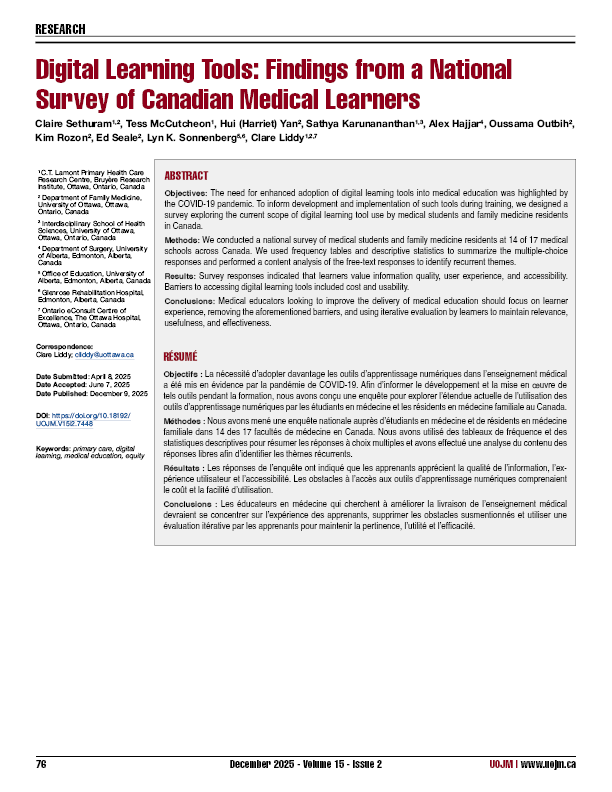
Digital Learning Tools: Findings from a National Survey of Canadian Medical Learners
DOI:
https://doi.org/10.18192/uojm.v15i2.7448Keywords:
primary care, digital learning, medical education, equityAbstract
Objectives: The need for enhanced adoption of digital learning tools into medical education was highlighted by the COVID-19 pandemic. To inform development and implementation of digital tools during training, we designed a survey exploring the current scope of digital learning tool use by medical students and family medicine residents in Canada.
Methods: We conducted a national survey of medical students and family medicine residents at 14/17 medical schools across Canada. We used frequency tables and descriptive statistics to summarize the multiple-choice responses and performed a content analysis of the free-text responses to identify recurrent themes.
Results: Survey responses indicated that learners value information quality, user experience, and accessibility. Barriers to accessing digital learning tools include cost and usability.
Conclusions: Medical educators looking to improve the delivery of medical education should focus on learner experience, removing the aforementioned barriers, and iterative evaluation by learners to maintain relevance, usefulness, and effectiveness.
----------
Objectifs : La nécessité d’adopter davantage les outils d’apprentissage numériques dans l’enseignement médical a été mis en évidence par la pandémie de COVID-19. Afin d’informer le développement et la mise en œuvre de tels outils pendant la formation, nous avons conçu une enquête pour explorer l’étendue actuelle de l’utilisation des outils d’apprentissage numériques par les étudiants en médecine et les résidents en médecine familiale au Canada.
Méthodes : Nous avons mené une enquête nationale auprès d’étudiants en médecine et de résidents en médecine familiale dans 14 des 17 facultés de médecine en Canada. Nous avons utilisé des tableaux de fréquence et des statistiques descriptives pour résumer les réponses à choix multiples et avons effectué une analyse du contenu des réponses libres afin d’identifier les thèmes récurrents.
Résultats : Les réponses de l’enquête ont indiqué que les apprenants apprécient la qualité de l’information, l’expérience utilisateur et l’accessibilité. Les obstacles à l’accès aux outils d’apprentissage numériques comprenaient le coût et la facilité d’utilisation.
Conclusions : Les éducateurs en médecine qui cherchent à améliorer la livraison de l’enseignement médical devraient se concentrer sur l’expérience des apprenants, supprimer les obstacles susmentionnés et utiliser une évaluation itérative par les apprenants pour maintenir la pertinence, l’utilité et l’efficacité.
References
O’Doherty D, Dromey M, Lougheed J, Hannigan A, Last J, McGrath D. Barriers and solutions to online learning in medical education - an integrative review. BMC Med Educ. 2018;18(1):130. doi:10.1186/s12909-018-1240-0
Shachar M, Neumann Y. Differences Between Traditional and Distance Education Academic Performances: A Meta-Analytic Approach. The International Review of Research in Open and Distributed Learning. 2003;4(2). doi:10.19173/irrodl.v4i2.153
Hopkins L, Hampton BS, Abbott JF, et al. To the point: medical education, technology, and the millennial learner. Am J Obstet Gynecol. 2018;218(2):188-192. doi:10.1016/j.ajog.2017.06.001
Edmonson, SR. Technology in Primary and Secondary Medical Education. In: Handbook of Research on Instructional Systems and Technology. IGI Global; 2008.
Nevin CR, Westfall AO, Rodriguez JM, et al. Gamification as a tool for enhancing graduate medical education. Postgrad Med J. 2014;90(1070):685-693. doi:10.1136/postgradmedj-2013-132486
Dankbaar M. Serious games and blended learning; effects on performance and motivation in medical education. Perspect Med Educ. 2017;6(1):58-60. doi:10.1007/s40037-016-0320-2
Pettit RK, McCoy L, Kinney M. What millennial medical students say about flipped learning. Adv Med Educ Pract. 2017;8:487-497. doi:10.2147/AMEP.S139569
Mangold K. Educating a new generation: teaching baby boomer faculty about millennial students. Nurse Educ. 2007;32(1):21-23. doi:10.1097/00006223-200701000-00007
Twenge JM. Generational changes and their impact in the classroom: teaching Generation Me. Med Educ. 2009;43(5):398-405. doi:10.1111/j.1365-2923.2009.03310.x
Wong, Roger. Medical education during COVID-19: Lessons from a pandemic. BCMJ. 2020;62(5):170-171.
Yan H, Rahgozar A, Sethuram C, et al. Natural Language Processing to Identify Digital Learning Tools in Postgraduate Family Medicine: Protocol for a Scoping Review. JMIR Res Protoc. 2022;11(5):e34575. doi:10.2196/34575
Roslan NS, Halim AS. Enablers and Barriers to Online Learning among Medical Students during COVID-19 Pandemic: An Explanatory Mixed-Method Study. Sustainability. 2021;13(11):6086. doi:10.3390/su13116086
Santoso HB, Schrepp M. The impact of culture and product on the subjective importance of user experience aspects. Heliyon. 2019;5(9):e02434. doi:10.1016/j.heliyon.2019.e02434
Kleinheksel AJ, Rockich-Winston N, Tawfik H, Wyatt TR. Demystifying Content Analysis. Am J Pharm Educ. 2020;84(1):7113. doi:10.5688/ajpe7113
Al-Balas M, Al-Balas HI, Jaber HM, et al. Distance learning in clinical medical education amid COVID-19 pandemic in Jordan: current situation, challenges, and perspectives. BMC Med Educ. 2020;20(1):341. doi:10.1186/s12909-020-02257-4
Bastos RA, Carvalho DR dos S, Brandão CFS, Bergamasco EC, Sandars J, Cecilio-Fernandes D. Solutions, enablers and barriers to online learning in clinical medical education during the first year of the COVID-19 pandemic: A rapid review. Medical Teacher. 2022;44(2):187-195. doi:10.1080/0142159X.2021.1973979
Peng S, Micks T, Braganza D, et al. Canadian national survey of family medicine residents on point-of-care ultrasound training. Can Fam Physician. 2019;65(12):e523-e530.
Falconer J, Couture F, Demir KK, Lang M, Shefman Z, Woo M. Perceptions and intentions toward medical assistance in dying among Canadian medical students. BMC Med Ethics. 2019;20(1):1-7. doi:10.1186/s12910-019-0356-z
Nagji A, Leslie K, Wong E, Myhre D, Young M, Chan MK. Something’s missing from my education: Using a cross sectional survey to examine the needs and interest of Canadian medical students relating to their roles as teachers and educators. Can Med Educ J. 2017;8(3):e21-e29.
Katz NJ, Lovrics O, Zevin B. A Canadian survey of medical students and undergraduate deans on the management of patients living with obesity. BMC Med Educ. 2022;22(1):1-10. doi:10.1186/s12909-022-03636-9
Khan R, Apramian T, Kang JH, Gustafson J, Sibbald S. Demographic and socioeconomic characteristics of Canadian medical students: a cross-sectional study. BMC Med Educ. 2020;20(1):1-8. doi:10.1186/s12909-020-02056-x
Robert P, Bégin F, Ménard-Castonguay S, et al. Attitude and knowledge of medical students about organ donation – training needs identified from a Canadian survey. BMC Med Educ. 2021;21(1):1-7. doi:10.1186/s12909-021-02736-2
Downloads
Published
How to Cite
Issue
Section
License
Copyright (c) 2025 Claire Sethuram, Tess McCutcheon, Hui (Harriet) Yan, Sathya Karunananthan, Alex Hajjar, Oussama Outbih, Kim Rozon, Ed Seale, Lyn Sonnenberg, Clare Liddy

This work is licensed under a Creative Commons Attribution-NonCommercial-NoDerivatives 4.0 International License.
- Authors publishing in the UOJM retain copyright of their articles, including all the drafts and the final published version in the journal.
- While UOJM does not retain any rights to the articles submitted, by agreeing to publish in UOJM, authors are granting the journal right of first publication and distribution rights of their articles.
- Authors are free to submit their works to other publications, including journals, institutional repositories or books, with an acknowledgment of its initial publication in UOJM.
- Copies of UOJM are distributed both in print and online, and all materials will be publicly available online. The journal holds no legal responsibility as to how these materials will be used by the public.
- Please ensure that all authors, co-authors and investigators have read and agree to these terms.
- Works are licensed under a Creative Commons Attribution-NonCommercial-NoDerivatives 4.0 International License.
