
Temporal Trends in Mental Health Terminology in Skin Cancer Clinical Trials from the ClinicalTrials.gov Database
Mental Health in Skin Cancer Trials
DOI:
https://doi.org/10.18192/uojm.v16i1.7898Keywords:
Anxiety, depression, Stress, Distress, Mental health, Clinical Trials, oncology, skin neoplasmsAbstract
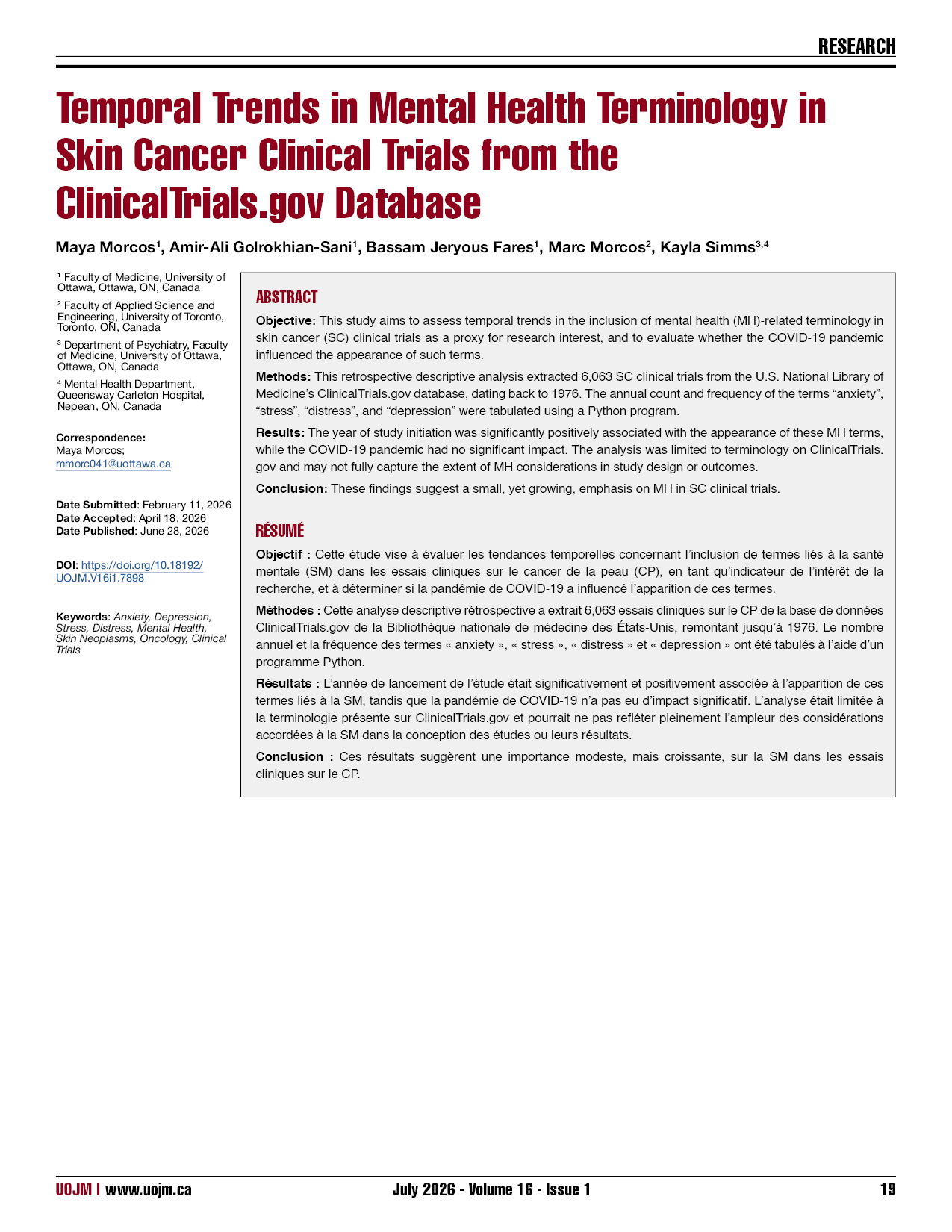
Objective: This study aims to assess temporal trends in the inclusion of mental health (MH)-related terminology in skin cancer (SC) clinical trials as a proxy for research interest, and to evaluate whether the COVID-19 pandemic influenced the appearance of such terms.
Methods: This retrospective descriptive analysis extracted 6,063 SC clinical trials from the U.S. National Library of Medicine’s ClinicalTrials.gov database, dating back to 1976. The annual count and frequency of the terms “anxiety”, “stress”, “distress”, and “depression” were tabulated using a Python program.
Results: The year of study initiation was significantly positively associated with the appearance of these MH terms, while the COVID-19 pandemic had no significant impact. The analysis was limited to terminology on ClinicalTrials.gov and may not fully capture the extent of MH considerations in study design or outcomes.
Conclusion: These findings suggest a small, yet growing, emphasis on MH in SC clinical trials.
----------
Objectif : Cette étude vise à évaluer les tendances temporelles concernant l’inclusion de termes liés à la santé mentale (SM) dans les essais cliniques sur le cancer de la peau (CP), en tant qu’indicateur de l’intérêt de la recherche, et à déterminer si la pandémie de COVID-19 a influencé l’apparition de ces termes.
Méthodes : Cette analyse descriptive rétrospective a extrait 6,063 essais cliniques sur le CP de la base de données ClinicalTrials.gov de la Bibliothèque nationale de médecine des États-Unis, remontant jusqu’à 1976. Le nombre annuel et la fréquence des termes « anxiety », « stress », « distress » et « depression » ont été tabulés à l’aide d’un programme Python.
Résultats : L’année de lancement de l’étude était significativement et positivement associée à l’apparition de ces termes liés à la SM, tandis que la pandémie de COVID-19 n’a pas eu d’impact significatif. L’analyse était limitée à la terminologie présente sur ClinicalTrials.gov et pourrait ne pas refléter pleinement l’ampleur des considérations accordées à la SM dans la conception des études ou leurs résultats.
Conclusion : Ces résultats suggèrent une importance modeste, mais croissante, sur la SM dans les essais cliniques sur le CP.
References
1. Linares MA, Zakaria A, Nizran P. Skin Cancer. Prim Care Clin Off Pract. 2015 Dec;42(4):645–59. doi:10.1016/j.pop.2015.07.006
2. International Agency for Research on Cancer. IARC [Internet]. 2024. Skin cancer. Availa-ble from: https://www.iarc.who.int/cancer-type/skin-cancer/
3. US Department of Health and Human Services. The Surgeon General’s Call to Action to Prevent Skin Cancer. [Internet]. Washington (DC): Office of the Surgeon General; 2014. Available from: https://www.ncbi.nlm.nih.gov/books/NBK247164/
4. Gogas HJ, Karalexi MA, Dessypris N, Antoniadis AG, Papadopoulos F, Petridou ET. The role of depression and personality traits in patients with melanoma: a South-European study. Melanoma Res. 2017 Dec;27(6):625–31. doi:10.1097/CMR.0000000000000380
5. Kasparian NA, McLoone JK, Butow PN. Psychological Responses and Coping Strategies Among Patients With Malignant Melanoma: A Systematic Review of the Literature. Arch Dermatol. 2009 Dec 1;145(12). doi:10.1001/archdermatol.2009.308
6. National Cancer Institute. National Cancer Institute [Internet]. 2024. Cancer-Related Post-Traumatic Stress (PDQ®)–Patient Version. Available from: https://www.cancer.gov/about-cancer/coping/survivorship/new-normal/ptsd-pdq
7. Radiotis G, Roberts N, Czajkowska Z, Khanna M, Körner A. Nonmelanoma Skin Cancer: Disease-Specific Quality-of-Life Concerns and Distress. Oncol Nurs Forum. 2014 Jan 1;41(1):57–65. doi:10.1188/14.ONF.57-65
8. Tkachenko E, Singer S, Mostaghimi A, Hartman RI. Association of poor mental health and skin cancer development: a cross-sectional study of adults in the United States. Eur J Can-cer Prev. 2020 Nov;29(6):520–2. doi:10.1097/CEJ.0000000000000567
9. Hong YR, Yadav S, Suk R, Khanijahani A, Erim D, Turner K. Patient-provider discussion about emotional and social needs, mental health outcomes, and benefit finding among U.S. Adults living with cancer. Cancer Med. 2021 Jun;10(11):3622–34. doi:10.1002/cam4.3918
10. Roberts N, Czajkowska Z, Radiotis G, Körner A. Distress and Coping Strategies Among Pa-tients with Skin Cancer. J Clin Psychol Med Settings. 2013 Jun;20(2):209–14. doi:10.1007/s10880-012-9319-y
11. Hulin C, Hansen T, Heron L, Pughe R, Streetly M, Plate A, et al. Living with the burden of relapse in multiple myeloma from the patient and physician perspective. Leuk Res. 2017 Aug;59:75–84. doi:10.1016/j.leukres.2017.05.019
12. Smith HR. Depression in cancer patients: Pathogenesis, implications and treatment (Re-view). Oncol Lett. 2015 Apr;9(4):1509–14. doi:10.3892/ol.2015.2944
13. Kungwengwe G, Gowthorpe C, Ali SR, Warren H, Drury DJ, Ang KL, et al. Prevalence and odds of anxiety and depression in cutaneous malignant melanoma: a proportional meta-analysis and regression. Br J Dermatol. 2024 Jun 20;191(1):24–35. doi:10.1093/bjd/ljae011
14. Kontoangelos K, Nikolaou V, Syrgianni A, Tsiori S, Papageorgiou C, Stratigos A. Correla-tion of Psychosomatic Factors and Personality Traits With the Severity of Melanoma. Vivo Athens Greece. 2024;38(6):2844–52. doi:10.21873/invivo.13765
15. Hernández-Torrano D, Ibrayeva L, Sparks J, Lim N, Clementi A, Almukhambetova A, et al. Mental Health and Well-Being of University Students: A Bibliometric Mapping of the Lit-erature. Front Psychol. 2020 Jun 9;11:1226. doi:10.3389/fpsyg.2020.01226
16. Golrokhian-Sani AA, Morcos M, Philippi A, Al-Rawi R, Morcos M, Rui F. Temporal Trends in Mental Health Terminology in Alzheimer’s Disease Clinical Trials. PLOS ONE. Forthcoming. 2024;19(12):e0310264. doi:10.1371/journal.pone.0310264
17. Morcos M, Jeryous Fares B, Golrokhian-Sani AA, Morcos M, Flannigan R, Breau RH, et al. Prevalence of mental health evaluation in erectile dysfunction clinical trials. J Sex Med. 2025 Jul 23;22(9):1665-72. doi:10.1093/jsxmed/qdaf173
18. Phillips B, Singh H, Morcos M, Golrokhian-Sani AA, Morcos M, Fu R. Trends in Neuro-psychiatric Terminology Use Within Registered Clinical Trials for Multiple Sclerosis: A Retrospective Descriptive Analysis. Healthcare. 2025 Jan;13(20):2593. doi:10.3390/healthcare13202593
19. IBM SPSS Statistics for Windows. Version 29.0.2.0. IBM Corp; 2024.
20. Schomerus G, Schwahn C, Holzinger A, Corrigan PW, Grabe HJ, Carta MG, et al. Evolution of public attitudes about mental illness: a systematic review and meta-analysis: Evolution of public attitudes. Acta Psychiatr Scand. 2012 Jun;125(6):440–52. doi:10.1111/j.1600-0447.2012.01826.x
21. Angermeyer MC, Matschinger H, Schomerus G. Attitudes towards psychiatric treatment and people with mental illness: changes over two decades. Br J Psychiatry. 2013 Aug;203(2):146–51. doi:10.1192/bjp.bp.112.122978
22. Johnson AL. Changes in Mental Health and Treatment, 1997–2017. J Health Soc Behav. 2021 Mar;62(1):53–68. doi:10.1177/0022146520984136
23. Colucci R, Moretti S. The role of stress and beta-adrenergic system in melanoma: current knowledge and possible therapeutic options. J Cancer Res Clin Oncol. 2016 May;142(5):1021–9. doi:10.1007/s00432-015-2078-z
24. Sanzo M, Colucci R, Arunachalam M, Berti S, Moretti S. Stress as a Possible Mechanism in Melanoma Progression. Davids LM, editor. Dermatol Res Pract. 2010 Jan;2010(1):483493. doi:10.1155/2010/483493
25. Cullen W, Gulati G, Kelly BD. Mental health in the COVID-19 pandemic. QJM Int J Med. 2020 May 1;113(5):311–2. doi:10.1093/qjmed/hcaa110
26. Sathian B, Asim M, Banerjee I, Pizarro AB, Roy B, van Teijlingen ER, et al. Impact of COVID-19 on clinical trials and clinical research: A systematic review. Nepal J Epidemiol. 2020 Sep;10(3):878–87. doi:10.3126/nje.v10i3.31622
27. AlNaamani K, AlSinani S, Barkun AN. Medical research during the COVID-19 pandemic. World J Clin Cases. 2020 Aug 6;8(15):3156–63. doi:10.12998/wjcc.v8.i15.3156
28. Wager E, McGough M, Rakshit S, Cox C. How does health spending in the U.S. compare to other countries? [Internet]. Peterson-KFF; 2026 Mar. (Health Spending). Available from: https://www.healthsystemtracker.org/chart-collection/health-spending-u-s-compare-countries/#Health%20expenditures%20as%20percent%20of%20GDP,%201970-2023
29. Morris ZS, Wooding S, Grant J. The answer is 17 years, what is the question: understanding time lags in translational research. J R Soc Med. 2011 Dec;104(12):510–20. doi:10.1258/jrsm.2011.110180
30. Bhakta S, Brambert L, Bartlett G, Palnati SR, Mynam RS. Exploring the Psychological Ex-periences of Patients With Melanoma: A Narrative Review. Cureus. 2025 Feb 25;17(2):e79637. doi:10.7759/cureus.79637
31. Andersen I, Thielen K, Bech P, Nygaard E, Diderichsen F. Increasing prevalence of depres-sion from 2000 to 2006. Scand J Public Health. 2011 Dec;39(8):857–63. doi:10.1177/1403494811424611
32. Klerman GL. Increasing Rates of Depression. JAMA J Am Med Assoc. 1989 Apr 21;261(15):2229. doi:10.1001/jama.1989.03420150079041
Downloads
Additional Files
Published
How to Cite
Issue
Section
License
Copyright (c) 2026 Maya Morcos, Amir-Ali Golrokhian-Sani, Bassam Jeryous Fares, Marc Morcos, Kayla Simms

This work is licensed under a Creative Commons Attribution-NonCommercial-NoDerivatives 4.0 International License.
- Authors publishing in the UOJM retain copyright of their articles, including all the drafts and the final published version in the journal.
- While UOJM does not retain any rights to the articles submitted, by agreeing to publish in UOJM, authors are granting the journal right of first publication and distribution rights of their articles.
- Authors are free to submit their works to other publications, including journals, institutional repositories or books, with an acknowledgment of its initial publication in UOJM.
- Copies of UOJM are distributed both in print and online, and all materials will be publicly available online. The journal holds no legal responsibility as to how these materials will be used by the public.
- Please ensure that all authors, co-authors and investigators have read and agree to these terms.
- Works are licensed under a Creative Commons Attribution-NonCommercial-NoDerivatives 4.0 International License.
