
Evaluating the Effect of a Pre-Arrival CPR Checklist on Resuscitation Quality During a Simulated Cardiac Arrest
DOI:
https://doi.org/10.18192/uojm.v15i2.7335Keywords:
CPR, Resuscitation, Simulation, checklist, cardiac arrestAbstract
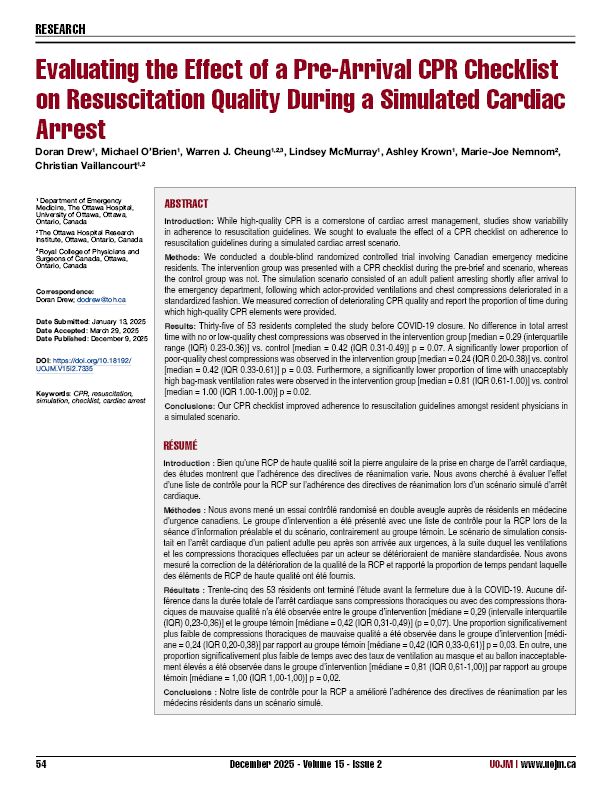
Objectives: While high-quality CPR is a cornerstone of cardiac arrest management, studies show variability in adherence to resuscitation guidelines. We sought to evaluate the effect of a CPR checklist on adherence to resuscitation guidelines during a simulated cardiac arrest scenario.
Methods: We conducted a double-blind randomized controlled trial involving Canadian emergency medicine residents. The intervention group was presented with a CPR checklist during the pre-brief and scenario, whereas the control group was not. The simulation scenario consisted of an adult patient arresting shortly after arrival to the emergency department, following which actor-provided ventilations and chest compressions deteriorated in a standardized fashion. We measured correction of deteriorating CPR quality and report the proportion of time during which high-quality CPR elements were provided.
Results: Thirty-five of 53 residents completed the study before COVID-19 closure. No difference in total arrest time with no or low-quality chest compressions was observed in the intervention group [median = 0.29 (interquartile range (IQR) 0.29-0.38)] vs. control [median = 0.42 (IQR 0.31-0.49)] p = 0.07. A significantly lower proportion of poor-quality chest compressions was observed in the intervention group [median = 0.24 (IQR 0.20-0.38)] vs. control [median = 0.42 (IQR 0.33-0.61)] p = 0.03. Furthermore, a significantly lower proportion of time with unacceptably high bag-mask ventilation rates were observed in the intervention group [median = 0.81 (IQR 0.61-1.00)] vs. control [median = 1.00 (IQR 1.00-1.00)] p = 0.02.
Conclusions: Our CPR checklist improved adherence to resuscitation guidelines amongst resident physicians in a simulated scenario.
----------
Introduction : Bien qu’une RCP de haute qualité soit la pierre angulaire de la prise en charge de l’arrêt cardiaque, des études montrent que l’adhérence des directives de réanimation varie. Nous avons cherché à évaluer l’effet d’une liste de contrôle pour la RCP sur l’adhérence des directives de réanimation lors d’un scénario simulé d’arrêt cardiaque.
Méthodes : Nous avons mené un essai contrôlé randomisé en double aveugle auprès de résidents en médecine d’urgence canadiens. Le groupe d’intervention a été présenté avec une liste de contrôle pour la RCP lors de la séance d’information préalable et du scénario, contrairement au groupe témoin. Le scénario de simulation consistait en l’arrêt cardiaque d’un patient adulte peu après son arrivée aux urgences, à la suite duquel les ventilations et les compressions thoraciques effectuées par un acteur se détérioraient de manière standardisée. Nous avons mesuré la correction de la détérioration de la qualité de la RCP et rapporté la proportion de temps pendant laquelle des éléments de RCP de haute qualité ont été fournis.
Résultats : Trente-cinq des 53 résidents ont terminé l’étude avant la fermeture due à la COVID-19. Aucune différence dans la durée totale de l’arrêt cardiaque sans compressions thoraciques ou avec des compressions thoraciques de mauvaise qualité n’a été observée entre le groupe d’intervention [médiane = 0,29 (intervalle interquartile (IQR) 0,23-0,36)] et le groupe témoin [médiane = 0,42 (IQR 0,31-0,49)] (p = 0,07). Une proportion significativement plus faible de compressions thoraciques de mauvaise qualité a été observée dans le groupe d’intervention [médiane = 0,24 (IQR 0,20-0,38)] par rapport au groupe témoin [médiane = 0,42 (IQR 0,33-0,61)] p = 0,03. En outre, une proportion significativement plus faible de temps avec des taux de ventilation au masque et au ballon inacceptablement élevés a été observée dans le groupe d’intervention [médiane = 0,81 (IQR 0,61-1,00)] par rapport au groupe témoin [médiane = 1,00 (IQR 1,00-1,00)] p = 0,02.
Conclusions : Notre liste de contrôle pour la RCP a amélioré l’adhérence des directives de réanimation par les médecins résidents dans un scénario simulé.
References
1. Meaney PA, Bobrow BJ, Mancini ME, Christenson J, de Caen AR, Bhanji F, et al. Cardiopulmonary Resuscitation Quality: Improving Cardiac Resuscitation Outcomes Both Inside and Outside the Hospital. Circulation [Internet]. 2013 Jul 23 [cited 2018 Dec 11];128(4):417–35. Available from: https://www.ahajournals.org/doi/10.1161/CIR.0b013e31829d8654
2. Perkins GD, Handley AJ, Koster RW, Castrén M, Smyth MA, Olasveengen T, et al. European Resuscitation Council Guidelines for Resuscitation 2015. Section 2. Adult basic life support and automated external defibrillation. Resuscitation. 2015 Oct 1;95:81–99.
3. Cheskes S, Schmicker RH, Verbeek PR, Salcido DD, Brown SP, Brooks S, et al. The impact of peri-shock pause on survival from out-of-hospital shockable cardiac arrest during the Resuscitation Outcomes Consortium PRIMED trial. Resuscitation [Internet]. 2014 Mar [cited 2018 Nov 5];85(3):336–42. Available from: http://www.ncbi.nlm.nih.gov/pubmed/24513129
4. Idris AH, Guffey D, Aufderheide TP, Brown S, Morrison LJ, Nichols P, et al. Relationship Between Chest Compression Rates and Outcomes From Cardiac Arrest. Circulation [Internet]. 2012 Jun 19 [cited 2018 Dec 11];125(24):3004–12. Available from: http://www.ncbi.nlm.nih.gov/pubmed/22623717
5. Idris AH, Guffey D, Pepe PE, Brown SP, Brooks SC, Callaway CW, et al. Chest Compression Rates and Survival Following Out-of-Hospital Cardiac Arrest*. Crit Care Med [Internet]. 2015 Apr [cited 2018 Dec 11];43(4):840–8. Available from: http://www.ncbi.nlm.nih.gov/pubmed/25565457
6. Stiell IG, Brown SP, Christenson J, Cheskes S, Nichol G, Powell J, et al. What is the role of chest compression depth during out-of-hospital cardiac arrest resuscitation?*. Crit Care Med [Internet]. 2012 Apr [cited 2018 Dec 11];40(4):1192–8. Available from: http://www.ncbi.nlm.nih.gov/pubmed/22202708
7. Christenson J, Andrusiek D, Everson-Stewart S, Kudenchuk P, Hostler D, Powell J, et al. Chest Compression Fraction Determines Survival in Patients With Out-of-Hospital Ventricular Fibrillation. Circulation [Internet]. 2009 Sep 29 [cited 2018 Dec 11];120(13):1241–7. Available from: http://www.ncbi.nlm.nih.gov/pubmed/19752324
8. Kleinman ME, Brennan EE, Goldberger ZD, Swor RA, Terry M, Bobrow BJ, et al. Part 5: Adult Basic Life Support and Cardiopulmonary Resuscitation Quality. Circulation [Internet]. 2015 Nov 3 [cited 2018 Dec 12];132(18 suppl 2):S414–35. Available from: http://www.ncbi.nlm.nih.gov/pubmed/26472993
9. Cheskes S, Schmicker RH, Rea T, Morrison LJ, Grunau B, Drennan IR, et al. The association between AHA CPR quality guideline compliance and clinical outcomes from out-of-hospital cardiac arrest. Resuscitation [Internet]. 2017 Jul [cited 2018 Dec 11];116:39–45. Available from: http://www.ncbi.nlm.nih.gov/pubmed/28476474
10. Høyer CB, Christensen EF, Eika B. Junior physician skill and behaviour in resuscitation: A simulation study. Resuscitation [Internet]. 2009 Feb [cited 2018 Dec 11];80(2):244–8. Available from: http://www.ncbi.nlm.nih.gov/pubmed/19084318
11. Brennan EE, McGraw RC, Brooks SC. Accuracy of instructor assessment of chest compression quality during simulated resuscitation. CJEM [Internet]. 2016 Jul 18 [cited 2018 Dec 11];18(04):276–82. Available from: http://www.ncbi.nlm.nih.gov/pubmed/26775890
12. Haffner L, Mahling M, Muench A, Castan C, Schubert P, Naumann A, et al. Improved recognition of ineffective chest compressions after a brief Crew Resource Management (CRM) training: a prospective, randomised simulation study. BMC Emerg Med [Internet]. 2017 [cited 2018 Dec 11];17(1):7. Available from: http://www.ncbi.nlm.nih.gov/pubmed/28253848
13. Fernandez Castelao E, Boos M, Ringer C, Eich C, Russo SG. Effect of CRM team leader training on team performance and leadership behavior in simulated cardiac arrest scenarios: a prospective, randomized, controlled study. BMC Med Educ [Internet]. 2015 Dec 24 [cited 2018 Aug 13];15(1):116. Available from: http://bmcmededuc.biomedcentral.com/articles/10.1186/s12909-015-0389-z
14. Langdorf MI, Strom SL, Yang L, Canales C, Anderson CL, Amin A, et al. High-Fidelity Simulation Enhances ACLS Training. Teach Learn Med [Internet]. 2014 Jul 3 [cited 2018 Aug 13];26(3):266–73. Available from: http://www.tandfonline.com/doi/abs/10.1080/10401334.2014.910466
15. Sullivan NJ, Duval-Arnould J, Twilley M, Smith SP, Aksamit D, Boone-Guercio P, et al. Simulation exercise to improve retention of cardiopulmonary resuscitation priorities for in-hospital cardiac arrests: A randomized controlled trial. Resuscitation [Internet]. 2015 Jan [cited 2018 Aug 13];86:6–13. Available from: http://linkinghub.elsevier.com/retrieve/pii/S0300957214008053
16. Espey E, Baty G, Rask J, Chungtuyco M, Pereda B, Leeman L. Emergency in the clinic: a simulation curriculum to improve outpatient safety. Am J Obstet Gynecol [Internet]. 2017 Dec [cited 2018 Dec 11];217(6):699.e1-699.e13. Available from: http://www.ncbi.nlm.nih.gov/pubmed/28919404
17. Surcouf JW, Chauvin SW, Ferry J, Yang T, Barkemeyer B. Enhancing residents’ neonatal resuscitation competency through unannounced simulation-based training. Med Educ Online [Internet]. 2013 Mar 21 [cited 2018 Aug 13];18:1–7. Available from: http://www.ncbi.nlm.nih.gov/pubmed/23522399
18. Hall AK, Damon Dagnone J, Moore S, Woolfrey KGH, Ross JA, McNeil G, et al. Comparison of Simulation-based Resuscitation Performance Assessments With In-training Evaluation Reports in Emergency Medicine Residents: A Canadian Multicenter Study. Santen S, editor. AEM Educ Train [Internet]. 2017 Oct [cited 2018 Dec 11];1(4):293–300. Available from: http://doi.wiley.com/10.1002/aet2.10055
19. Powell-Dunford N, Brennan PA, Peerally MF, Kapur N, Hynes JM, Hodkinson PD. Mindful Application of Aviation Practices in Healthcare. Aerosp Med Hum Perform [Internet]. 2017 Dec 1 [cited 2018 Nov 5];88(12):1107–16. Available from: http://www.ncbi.nlm.nih.gov/pubmed/29157340
20. van Klei WA, Hoff RG, van Aarnhem EEHL, Simmermacher RKJ, Regli LPE, Kappen TH, et al. Effects of the Introduction of the WHO “Surgical Safety Checklist” on In-Hospital Mortality. Ann Surg [Internet]. 2012 Jan [cited 2019 Jan 15];255(1):44–9. Available from: http://www.ncbi.nlm.nih.gov/pubmed/22123159
21. Haynes AB, Weiser TG, Berry WR, Lipsitz SR, Breizat A-HS, Dellinger EP, et al. A Surgical Safety Checklist to Reduce Morbidity and Mortality in a Global Population. N Engl J Med [Internet]. 2009 Jan 29 [cited 2019 Jan 15];360(5):491–9. Available from: http://www.nejm.org/doi/abs/10.1056/NEJMsa0810119
22. Chen C, Kan T, Li S, Qiu C, Gui L. Use and implementation of standard operating procedures and checklists in prehospital emergency medicine: a literature review. Am J Emerg Med [Internet]. 2016 Dec [cited 2019 Jan 15];34(12):2432–9. Available from: http://www.ncbi.nlm.nih.gov/pubmed/27742522
23. Kerrey BT, Mittiga MR, Rinderknecht AS, Varadarajan KR, Dyas JR, Geis GL, et al. Reducing the incidence of oxyhaemoglobin desaturation during rapid sequence intubation in a paediatric emergency department. BMJ Qual Saf [Internet]. 2015 Nov [cited 2019 Jan 15];24(11):709–17. Available from: http://www.ncbi.nlm.nih.gov/pubmed/26183713
24. Sealed Envelope Ltd. Create a blocked randomisation list. [Internet]. [cited 2019 Aug 7]. Available from: https://www.sealedenvelope.com/simple-randomiser/v1/lists
25. Baylis J, Heyd C, Thoma B, Hall AK, Chaplin T, Petrosoniak A, et al. Development of a national, standardized simulation case template. Can J Emerg Med. 2020 Nov 1;22(6):822–4.
26. Kirkpatrick DL. Evaluation in Training. In: Training and Development Handbook. New York, NY: McGraw Hill; 1967. p. 87–112.
27. Eppich W, Cheng A. Promoting Excellence and Reflective Learning in Simulation (PEARLS). Simul Healthc J Soc Simul Healthc [Internet]. 2015 Apr [cited 2019 Jan 15];10(2):106–15. Available from: https://insights.ovid.com/crossref?an=01266021-201504000-00007
28. Clay-Williams R, Colligan L. Back to basics: checklists in aviation and healthcare. BMJ Qual Saf [Internet]. 2015 Jul [cited 2018 Nov 5];24(7):428–31. Available from: http://www.ncbi.nlm.nih.gov/pubmed/25969512
29. Bleetman A, Sanusi S, Dale T, Brace S. Human factors and error prevention in emergency medicine. Emerg Med J [Internet]. 2012 May [cited 2019 Jan 15];29(5):389–93. Available from: http://www.ncbi.nlm.nih.gov/pubmed/21565880
30. van Dawen J, Vogt L, Schröder H, Rossaint R, Henze L, Beckers SK, et al. The role of a checklist for assessing the quality of basic life support performance: An observational cohort study. Scand J Trauma Resusc Emerg Med. 2018 Nov 16;26(1).
31. Beskind DL, Stolz U, Thiede R, Hoyer R, Robertson W, Brown J, et al. Viewing an ultra-brief chest compression only video improves some measures of bystander CPR performance and responsiveness at a mass gathering event. Resuscitation [Internet]. 2017 Sep [cited 2018 Aug 13];118:96–100. Available from: http://linkinghub.elsevier.com/retrieve/pii/S0300957217302927
32. Beskind DL, Stolz U, Thiede R, Hoyer R, Burns W, Brown J, et al. Viewing a brief chest-compression-only CPR video improves bystander CPR performance and responsiveness in high school students: A cluster randomized trial. Resuscitation. 2016 Jul 1;104:28–33.
33. Arriaga AF, Bader AM, Wong JM, Lipsitz SR, Berry WR, Ziewacz JE, et al. Simulation-Based Trial of Surgical-Crisis Checklists. N Engl J Med. 2013 Jan 17;368(3):246–53.
Downloads
Additional Files
Published
How to Cite
Issue
Section
License
Copyright (c) 2025 Doran Drew, Michael O'Brien, Warren Cheung, Lindsey McMurray, Ashley Krown, Marie-Joe Nemnom, Christian Vaillancourt

This work is licensed under a Creative Commons Attribution-NonCommercial-NoDerivatives 4.0 International License.
- Authors publishing in the UOJM retain copyright of their articles, including all the drafts and the final published version in the journal.
- While UOJM does not retain any rights to the articles submitted, by agreeing to publish in UOJM, authors are granting the journal right of first publication and distribution rights of their articles.
- Authors are free to submit their works to other publications, including journals, institutional repositories or books, with an acknowledgment of its initial publication in UOJM.
- Copies of UOJM are distributed both in print and online, and all materials will be publicly available online. The journal holds no legal responsibility as to how these materials will be used by the public.
- Please ensure that all authors, co-authors and investigators have read and agree to these terms.
- Works are licensed under a Creative Commons Attribution-NonCommercial-NoDerivatives 4.0 International License.
