
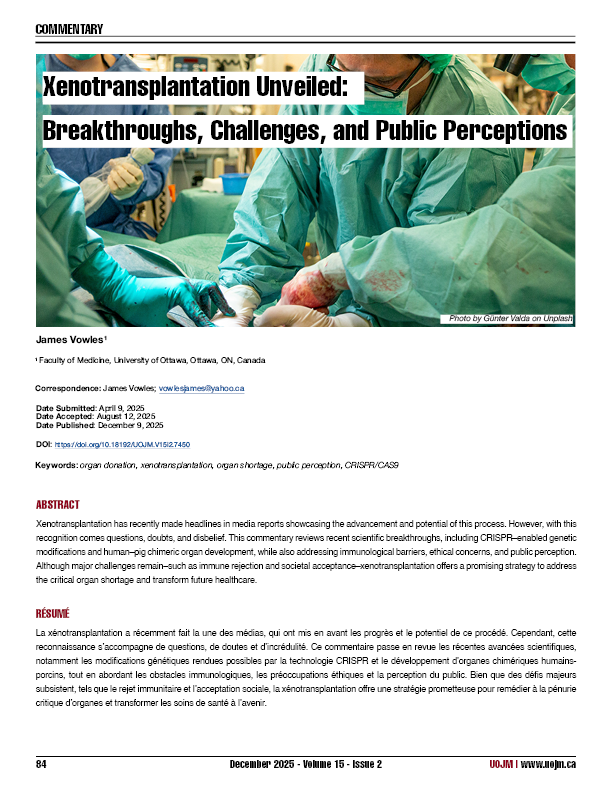
Xenotransplantation Unveiled: Breakthroughs, Challenges, and Public Perceptions
DOI :
https://doi.org/10.18192/uojm.v15i2.7450Mots-clés :
Xenotransplantation, Organ Shortage, Gene Editing, CRISPR/CAS9, Organ Donation, Public Perception, Immunological Rejection, Cross-Species Transplantation, Bioethics, Regenerative MedicineRésumé
Xenotransplantation has recently made headlines in recent media reports showcasing the advancement and potential of this process. However, with this recognition comes questions, doubts, and disbelief. The primary aim of this paper is to traverse and unravel what xenotransplantation is, discuss recent breakthroughs, benefits and challenges as well as consider societal perceptions. Ultimately, this discussion will bridge the gap in knowledge with respect to the current public understanding of the state of xenotransplantation and its future healthcare implications.
----------
La xénotransplantation a récemment fait la une des médias, qui ont mis en avant les progrès et le potentiel de ce procédé. Cependant, cette reconnaissance s’accompagne de questions, de doutes et d’incrédulité. Ce commentaire passe en revue les récentes avancées scientifiques, notamment les modifications génétiques rendues possibles par la technologie CRISPR et le développement d’organes chimériques humains-porcins, tout en abordant les obstacles immunologiques, les préoccupations éthiques et la perception du public. Bien que des défis majeurs subsistent, tels que le rejet immunitaire et l’acceptation sociale, la xénotransplantation offre une stratégie prometteuse pour remédier à la pénurie critique d’organes et transformer les soins de santé à l’avenir.
Références
Government of Canada [Internet]. / Gouvernement du Canada; 2023 [cited 2023 Sept 14]. Available from: https://www.canada.ca/en/health-canada/services/healthy-living/blood-organ-tissue-donation/organ-tissue.html
Cotrau P, Hodosan V, Vladu A, Daina C, Daina LG, Pantis C. Ethical, Socio-Cultural and Religious Issues in Organ Donation. Maedica (Bucur). 2019 Mar;14(1):12-14. Greek, Modern. doi: 10.26574/maedica.2019.14.1.12. PMID: 31123506; PMCID: PMC6511665.
Tennankore KK, Klarenbach S, Goldberg A. Perspectives on Opt-Out Versus Opt-In Legislation for Deceased Organ Donation: An Opinion Piece. Can J Kidney Health Dis. 2021 Jun 16;8:20543581211022151. doi: 10.1177/20543581211022151. PMID: 34188947; PMCID: PMC8212358.
Center for Biologics Evaluation and Research. Xenotransplantation [Internet]. FDA; [cited 2023 Sept 14]. Available from: https://www.fda.gov/vaccines-blood-biologics/xenotransplantation
Yoon CH, Choi HJ, Kim MK. Corneal xenotransplantation: Where are we standing? Prog Retin Eye Res. 2021 Jan;80:100876. doi: 10.1016/j.preteyeres.2020.100876. Epub 2020 Aug 2. PMID: 32755676; PMCID: PMC7396149.
Cooper DK. A brief history of cross-species organ transplantation. Proc (Bayl Univ Med Cent). 2012 Jan;25(1):49-57. doi: 10.1080/08998280.2012.11928783. PMID: 22275786; PMCID: PMC3246856.
Rodger D, Cooper DK. Kidney Xenotransplantation: Future clinical reality or science fiction? Nursing & Health Sciences. 2022;25(1):161–70. doi:10.1111/nhs.12994
Villiers CB de. Xenotransplantation: Gene editing animals for organ transplants to humans [Internet]. 2022 [cited 2023 Sept 14]. Available from: https://www.phgfoundation.org/briefing/xenotransplantation#:~:text=Pigs have become the most, offer advantages over other animals.
Carvalho-Oliveira M, Valdivia E, Blasczyk R, Figueiredo C. Immunogenetics of xenotransplantation. Int J Immunogenet. 2021 Apr;48(2):120-134. doi: 10.1111/iji.12526. Epub 2021 Jan 7. PMID: 33410582.
Vadori M, Cozzi E. Immunological challenges and therapies in xenotransplantation. Cold Spring Harb Perspect Med. 2014 Apr 1;4(4):a015578. doi: 10.1101/cshperspect.a015578. PMID: 24616201; PMCID: PMC3968789.
Bender M, Längin M, Reichart B, Mokelke M, Radan J, Neumann E, et al. Clinical cardiac xenotransplantation first in the clinical arena. Xenotransplantation. 2022 Jan;29(1):e12734. doi: 10.1111/xen.12734. Epub 2022 Feb 15. PMID: 35165939.
Wang J, Xie W, Li N, Li W, Zhang Z, Fan N, et al. Generation of a humanized mesonephros in pigs from induced pluripotent stem cells via embryo complementation. Cell Stem Cell. 2023 Sep 7;30(9):1235-1245.e6. doi: 10.1016/j.stem.2023.08.003. PMID: 37683604.
Griffith, B. P., Goerlich, C. E., Singh, A. K., Rothblatt, M., Lau, C. L., Shah, A., Lorber, M., Grazioli, A., Saharia, K. K., Hong, S. N., Joseph, S. M., Ayares, D., & Mohiuddin, M. M. (2022). Genetically modified porcine-to-human cardiac xenotransplantation. New England Journal of Medicine, 387(1), 35–44. https://doi.org/10.1056/nejmoa2201422
Allison, S. J. (2022). A model of pig-to-human kidney transplantation. Nature Reviews Nephrology, 18(4), 199–199. https://doi.org/10.1038/s41581-022-00550-7
Von Moos S, Akalin E, Mas V, Mueller TF. Assessment of Organ Quality in Kidney Transplantation by Molecular Analysis and Why It May Not Have Been Achieved, Yet. Front Immunol. 2020 May 12; 11:833. doi: 10.3389/fimmu.2020.00833. PMID: 32477343; PMCID: PMC7236771.
Schover, L. R., Streem, S. B., Boparai, N., Duriak, K., & Novick, A. C. (1997). The psychosocial impact of donating a kidney. The Journal of Urology, 1596–1600. https://doi.org/10.1097/00005392-199705000-00014
Organ transplant [Internet]. [cited 2023 Sept 14]. Available from:https://www.healthlinkbc.ca/health-topics/organ-transplant#:~:text=Organs most often transplanted include, failure, and other heart problems.
[Internet]. [cited 2023 Sept 14]. Available from: https://secure.cihi.ca/free_products/report-corr-high-risk-high-cost-en-web.pdf
Byrne, G., Ahmad‐Villiers, S., Du, Z., & McGregor, C. (2018). B4galnt2 and Xenotransplantation: A newly appreciated xenogeneic antigen. Xenotransplantation, 25(5). https://doi.org/10.1111/xen.12394
Denner J. Porcine Endogenous Retroviruses and Xenotransplantation, 2021. Viruses. 2021 Oct 26;13(11):2156. doi: 10.3390/v13112156. PMID: 34834962; PMCID: PMC8625113.
Kwon I (Bok-K, Mo H. Xenotransplantation. Encyclopedia of Global Bioethics. 2015;1–14. doi:10.1007/978-3-319-05544-2_449-1
ISSCR (2021). Guidelines for Stem Cell Research and Clinical Translation. https://www.isscr.org/guidelines
FDA (2024). Source Animal, Product, Preclinical, and Clinical Issues Concerning the Use of Xenotransplantation Products. Draft Guidance
Ríos A, Conesa C, Ramírez P, Galindo PJ, Rodríguez MM, Martínez L, et al. Hospital personnel faced with organ xenotransplantation: an attitudinal survey in a hospital with a pre-clinical liver xenotransplantation program. Xenotransplantation. 2006 Sep;13(5):447- 54. doi: 10.1111/j.1399-3089.2006.00334.x. PMID: 16925669.
Persson MO, Persson NH, Ranstam J, Hermerén G. Xenotransplantation public perceptions: rather cells than organs. Xenotransplantation. 2003 Jan;10(1):72-9. doi: 10.1034/j.1399- 3089.2003.01132. x. PMID: 12535228.
Téléchargements
Publié-e
Comment citer
Numéro
Rubrique
Licence
© James Vowles 2025

Cette œuvre est sous licence Creative Commons Attribution - Pas d'Utilisation Commerciale - Pas de Modification 4.0 International.
- Les auteurs qui publient dans le JMUO gardent les droits d’auteur de leurs articles, incluant tous les brouillons et la copie finale publiée dans le journal
- Bien que le JMUO n’a pas les droits d’auteur des articles soumis, en acceptant de publier dans le JMUO, les auteurs donnent le droit au journal d’être les premiers à publier et à distribuer leurs articles.
- Par la suite, les auteurs peuvent soumettre leurs documents à d’autres publications, incluant des revues ou des livres, avec un remerciement de leur première publication dans le JMUO
- Des copies du JMUO seront distribuées à la fois sous format papier et en ligne, et tous les matériaux seront accessibles au public en ligne. Le journal n’a pas de responsabilité légale par rapport à la distribution publique du contenu.
- Prière de vous assurer que tous les auteurs, les coauteurs et les investigateurs
- Le contenu est rendu disponible sous licence Creative Commons Attribution - Pas d'Utilisation Commerciale - Pas de Modification 4.0 International.
