
Using AI to Predict Immunotherapy Response in Non-Small Cell Lung Cancer Patients
DOI :
https://doi.org/10.18192/uojm.v16i1.7562Mots-clés :
non-small cell lung cancer (NSCLC), machine learning, immunotherapy, logistic regression, Immune Checkpoint Inhibitors (ICI)Résumé
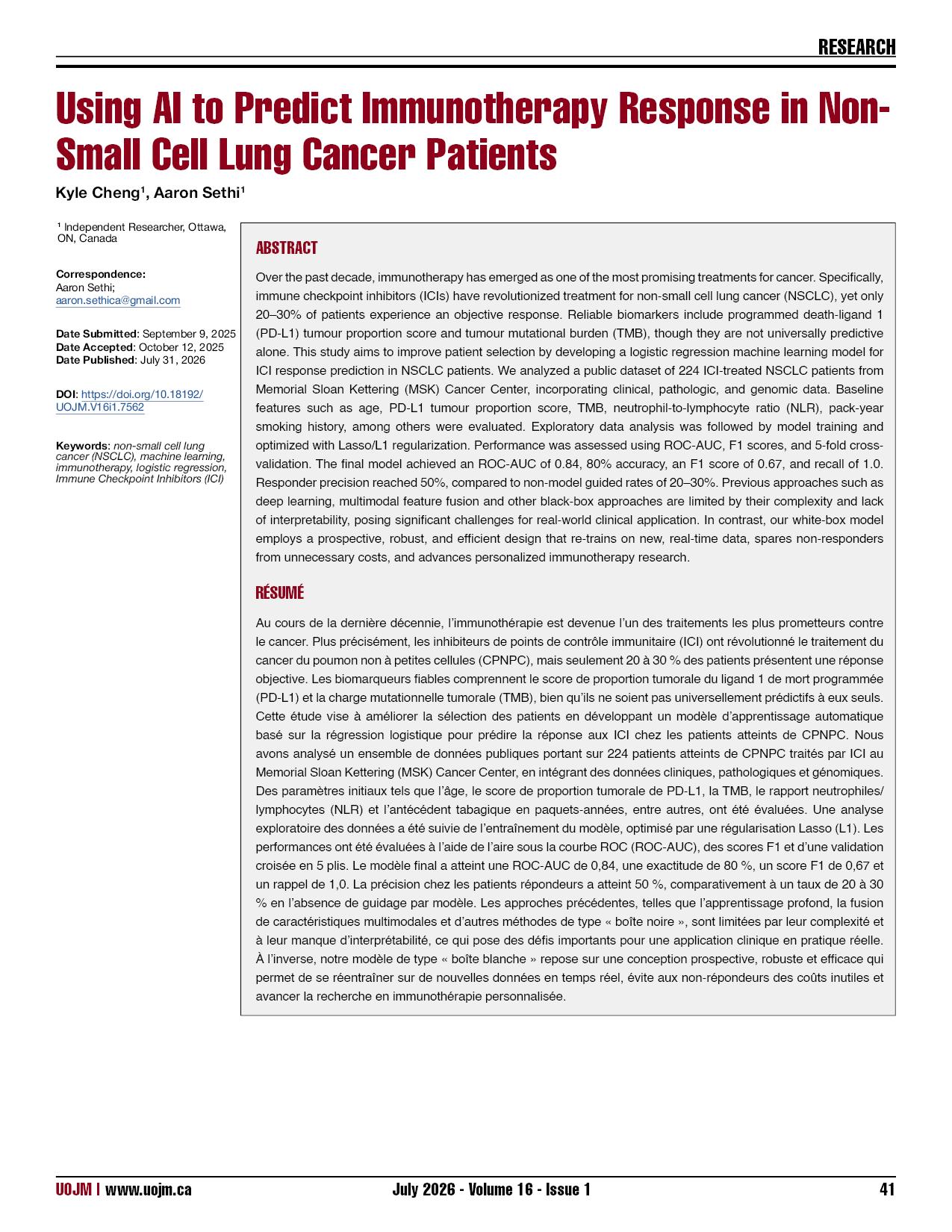
Over the past decade, immunotherapy has emerged as one of the most promising treatments for cancer. Specifically, immune checkpoint inhibitors (ICIs) have revolutionized treatment for non-small cell lung cancer (NSCLC), yet only 20–30% of patients experience an objective response. Reliable biomarkers include programmed death-ligand 1 (PD-L1) tumour proportion score and tumour mutational burden (TMB), though they are not universally predictive alone. This study aims to improve patient selection by developing a logistic regression machine learning model for ICI response prediction in NSCLC patients. We analyzed a public dataset of 224 ICI-treated NSCLC patients from Memorial Sloan Kettering (MSK) Cancer Center, incorporating clinical, pathologic, and genomic data. Baseline features such as age, PD-L1 tumour proportion score, TMB, neutrophil-to-lymphocyte ratio (NLR), pack-year smoking history, among others were evaluated. Exploratory data analysis was followed by model training and optimized with Lasso/L1 regularization. Performance was assessed using ROC-AUC, F1 scores, and 5-fold cross-validation. The final model achieved an ROC-AUC of 0.84, 80% accuracy, an F1 score of 0.67, and recall of 1.0. Responder precision reached 50%, compared to non-model guided rates of 20–30%. Previous approaches such as deep learning, multimodal feature fusion and other black-box approaches are limited by their complexity and lack of interpretability, posing significant challenges for real-world clinical application. In contrast, our white-box model employs a prospective, robust, and efficient design that re-trains on new, real-time data, spares non-responders from unnecessary costs, and advances personalized immunotherapy research.
----------
Au cours de la dernière décennie, l’immunothérapie est devenue l’un des traitements les plus prometteurs contre le cancer. Plus précisément, les inhibiteurs de points de contrôle immunitaire (ICI) ont révolutionné le traitement du cancer du poumon non à petites cellules (CPNPC), mais seulement 20 à 30 % des patients présentent une réponse objective. Les biomarqueurs fiables comprennent le score de proportion tumorale du ligand 1 de mort programmée (PD-L1) et la charge mutationnelle tumorale (TMB), bien qu’ils ne soient pas universellement prédictifs à eux seuls. Cette étude vise à améliorer la sélection des patients en développant un modèle d’apprentissage automatique basé sur la régression logistique pour prédire la réponse aux ICI chez les patients atteints de CPNPC. Nous avons analysé un ensemble de données publiques portant sur 224 patients atteints de CPNPC traités par ICI au Memorial Sloan Kettering (MSK) Cancer Center, en intégrant des données cliniques, pathologiques et génomiques. Des paramètres initiaux tels que l’âge, le score de proportion tumorale de PD-L1, la TMB, le rapport neutrophiles/lymphocytes (NLR) et l’antécédent tabagique en paquets-années, entre autres, ont été évaluées. Une analyse exploratoire des données a été suivie de l’entraînement du modèle, optimisé par une régularisation Lasso (L1). Les performances ont été évaluées à l’aide de l’aire sous la courbe ROC (ROC-AUC), des scores F1 et d’une validation croisée en 5 plis. Le modèle final a atteint une ROC-AUC de 0,84, une exactitude de 80 %, un score F1 de 0,67 et un rappel de 1,0. La précision chez les patients répondeurs a atteint 50 %, comparativement à un taux de 20 à 30 % en l’absence de guidage par modèle. Les approches précédentes, telles que l’apprentissage profond, la fusion de caractéristiques multimodales et d’autres méthodes de type « boîte noire », sont limitées par leur complexité et à leur manque d’interprétabilité, ce qui pose des défis importants pour une application clinique en pratique réelle. À l’inverse, notre modèle de type « boîte blanche » repose sur une conception prospective, robuste et efficace qui permet de se réentraîner sur de nouvelles données en temps réel, évite aux non-répondeurs des coûts inutiles et avancer la recherche en immunothérapie personnalisée.
Références
1. Ma, W., Xue, R., Zhu, Z. et al. Increasing cure rates of solid tumors by immune checkpoint inhibitors. Exp Hematol Oncol 12, 10 (2023). https://doi.org/10.1186/s40164-023-00372-8
2. Barcellini, L., Nardin, S., Sacco, G. et al. Immune Checkpoint Inhibitors and Targeted Therapies in Early-Stage Non-Small-Cell Lung Cancer: State-of-the-Art and Future Perspectives. Cancers 17, 652 (2025). https://doi.org/10.3390/cancers17040652
3. Ichihara, E., Harada, D., Inoue, K. et al. The impact of body mass index on the efficacy of anti-PD-1/PD-L1 antibodies in patients with non-small cell lung cancer. Lung Cancer 139, 140-145 (2020). https://doi.org/10.1016/j.lungcan.2019.11.011
4. Tan, W. W. Non-small cell lung cancer (NSCLC). Medscape Updated March 31, 2026. https://emedicine.medscape.com/article/279960-overview
5. Chen, Y. C., Chen, AY., Hong, R. et al. Optimizing T cell inflamed signature through a combination biomarker approach for predicting immunotherapy response in NSCLC. Sci Rep 14, 23617 (2024). https://doi.org/10.1038/s41598-024-82903-9
6. Catalano, M., Iannone, L. F., Nesi, G. et al. Immunotherapy-related biomarkers: Confirmations and uncertainties. Crit Rev Oncol Hematol 192, 104135 (2023). https://doi.org/10.1016/j.critrevonc.2023.104135
7. Bravaccini, S., Bronte, G. & Ulivi, P. TMB in NSCLC: A Broken Dream? Int J Mol Sci 22, 6536 (2021). https://doi.org/10.3390/ijms22126536
8. Liao, J., Li, X., Gan, Y. et al. Artificial intelligence assists precision medicine in cancer treatment. Front Oncol 12, 998222 (2023). https://doi.org/10.3389/fonc.2022.998222
9. Rezayi, S., Niakan Kalhori, S. R. & Saeedi, S. Effectiveness of Artificial Intelligence for Personalized Medicine in Neoplasms: A Systematic Review. Biomed Res Int 2022, 7842566 (2022). https://doi.org/10.1155/2022/7842566
10. University of Oxford. Study demonstrates how AI can develop more personalised cancer treatment strategies. University of Oxford News June 17, 2024. https://www.ox.ac.uk/news/2024-06-17-study-demonstrates-how-ai-can-develop-more-personalised-cancer-treatment-strategies
11. National Institutes of Health. AI tool predicts response to cancer therapy. NIH Research Matters January 22, 2025. https://www.nih.gov/news-events/nih-research-matters/ai-tool-predicts-response-cancer-therapy
12. Rakaee, M., Adib, E., Ricciuti, B. et al. Association of Machine Learning-Based Assessment of Tumor-Infiltrating Lymphocytes on Standard Histologic Images With Outcomes of Immunotherapy in Patients With NSCLC. JAMA Oncol 9, 51-60 (2023). https://doi.org/10.1001/jamaoncol.2022.4933
13. Vanguri, R. S., Luo, J., Aukerman, A. T. et al. Multimodal integration of radiology, pathology and genomics for prediction of response to PD-(L)1 blockade in patients with non-small cell lung cancer. Nat Cancer 3, 1151-1164 (2022). https://doi.org/10.1038/s41591-022-01976-9
14. Hua, Y., Stead, T. S., George, A. et al. Clinical Risk Prediction with Logistic Regression: Best Practices, Validation Techniques, and Applications in Medical Research. Acad Med Surg 1, 131964 (2025). https://doi.org/10.62186/001c.131964
15. Memorial Sloan Kettering Cancer Center. Non-Small Cell Lung Cancer (MSKCC, J Clin Oncol 2018): IMPACT sequencing of 240 NSCLC tumor/normal pairs treated at MSKCC with anti-PD-(L)1 based therapy. MSK Data Catalog 10608 (2018). https://datacatalog.mskcc.org/dataset/10608
16. Wang, J., Zeng, Z., Li, Z. et al. The clinical application of artificial intelligence in cancer precision treatment. J Transl Med 23, 120 (2025). https://doi.org/10.1186/s12967-025-06139-5
17. Rizvi, H., Sanchez-Vega, F., La, K. et al. Molecular Determinants of Response to Anti-Programmed Cell Death-1 and Anti-Programmed Death-Ligand 1 Blockade in Patients with Non-Small-Cell Lung Cancer Profiled by Targeted Next-Generation Sequencing. J Clin Oncol 36, 633-641 (2018). https://doi.org/10.1200/JCO.2017.75.3384
18.Eisenhauer, E. A., Therasse, P., Bogaerts, J. et al. New response evaluation criteria in solid tumours: revised RECIST guideline (version 1.1). Eur J Cancer 45, 228–247 (2009). https://doi.org/10.1016/j.ejca.2008.10.026.
19. Chawla, N. V., Bowyer, K. W., Hall, L. O. et al. SMOTE: synthetic minority over-sampling technique. J Artif Intell Res16, 321–357 (2002). https://doi.org/10.1613/jair.953
20. Python Software Foundation. Python programming language, version 3.9.6. 2021. Available from: python.org.
21. The Pandas Development Team. pandas-dev/pandas: Pandas. Zenodo; 2020. https://doi.org/10.5281/zenodo.3509134
22. Pedregosa F, Varoquaux G, Gramfort A, et al. Scikit-learn: machine learning in Python. J Mach Learn Res. 2011;12:2825–2830.
23. Waskom ML. seaborn: statistical data visualization. J Open Source Softw. 2021;6(60):3021. https://doi.org/10.21105/joss.03021
24. Hunter JD. Matplotlib: a 2D graphics environment. Comput Sci Eng. 2007;9(3):90–95. https://doi.org/10.1109/MCSE.2007.55
25. Wang, X., Ricciuti, B., Nguyen, T. et al. Association between Smoking History and Tumor Mutation Burden in Advanced Non-Small Cell Lung Cancer. Cancer Res 81, 2566-2573 (2021). https://doi.org/10.1158/0008-5472.CAN-20-3991
26. Sun, L. Y., Cen, W. J., Tang, W. T. et al. Smoking status combined with tumor mutational burden as a prognosis predictor for combination immune checkpoint inhibitor therapy in non-small cell lung cancer. Cancer Med 10, 6610-6617 (2021). https://doi.org/10.1002/cam4.4197
27. Mosca, M., Nigro, M. C., Pagani, R. et al. Neutrophil-to-Lymphocyte Ratio (NLR) in NSCLC, Gastrointestinal, and Other Solid Tumors: Immunotherapy and Beyond. Biomolecules 13, 1803 (2023). https://doi.org/10.3390/biom13121803
28. Valero, C., Lee, M., Hoen, D. et al. Pretreatment neutrophil-to-lymphocyte ratio and mutational burden as biomarkers of tumor response to immune checkpoint inhibitors. Nat Commun 12, 729 (2021). https://doi.org/10.1038/s41467-021-20935-9
29. Rajput, D., Wang, W. J. & Chen, C. C. Evaluation of a decided sample size in machine learning applications. BMC Bioinformatics 24, 48 (2023). https://doi.org/10.1186/s12859-023-05156-9
30. Hasin, Y., Seldin, M. & Lusis, A. Multi-omics approaches to disease. Genome Biol 18, 83 (2017). https://doi.org/10.1186/s13059-017-1215-1.
31. Raufaste-Cazavieille, V., Santiago, R. & Droit, A. Multi-omics analysis: Paving the path toward achieving precision medicine in cancer treatment and immuno-oncology. Front Mol Biosci 9, 962743 (2022). https://doi.org/10.3389/fmolb.2022.962743
32. Van Calster, B., McLernon, D. J., van Smeden, M. et al. Calibration: the Achilles heel of predictive analytics. BMC Med17, 230 (2019). https://doi.org/10.1186/s12916-019-1466-7
33. Van Houwelingen, J. C. & Le Cessie, S. Predictive value of statistical models. Stat Med 9, 1303-1325 (1990). https://doi.org/10.1002/sim.4780091109
34. Brownlee, J. How to Calibrate Probabilities for Imbalanced Classification. Machine Learning Mastery August 21, 2020. https://machinelearningmastery.com/how-to-calibrate-probabilities-for-imbalanced-classification/
Téléchargements
Publié-e
Comment citer
Numéro
Rubrique
Licence
© Kyle Cheng, Aaron Sethi 2026

Cette œuvre est sous licence Creative Commons Attribution - Pas d'Utilisation Commerciale - Pas de Modification 4.0 International.
- Les auteurs qui publient dans le JMUO gardent les droits d’auteur de leurs articles, incluant tous les brouillons et la copie finale publiée dans le journal
- Bien que le JMUO n’a pas les droits d’auteur des articles soumis, en acceptant de publier dans le JMUO, les auteurs donnent le droit au journal d’être les premiers à publier et à distribuer leurs articles.
- Par la suite, les auteurs peuvent soumettre leurs documents à d’autres publications, incluant des revues ou des livres, avec un remerciement de leur première publication dans le JMUO
- Des copies du JMUO seront distribuées à la fois sous format papier et en ligne, et tous les matériaux seront accessibles au public en ligne. Le journal n’a pas de responsabilité légale par rapport à la distribution publique du contenu.
- Prière de vous assurer que tous les auteurs, les coauteurs et les investigateurs
- Le contenu est rendu disponible sous licence Creative Commons Attribution - Pas d'Utilisation Commerciale - Pas de Modification 4.0 International.
