Solid Waste Management and Urban Sustainability: Monitoring SDG Indicator 11.6.1 in the City of Dakar (Senegal)
DOI:
https://doi.org/10.18192/cdibp.v1i1.7519Keywords:
household solid waste, urban sustainability, ODD 11.6.1 indicator, Controlled facilities, Waste flow Diagram, Waste Wise CitiesAbstract
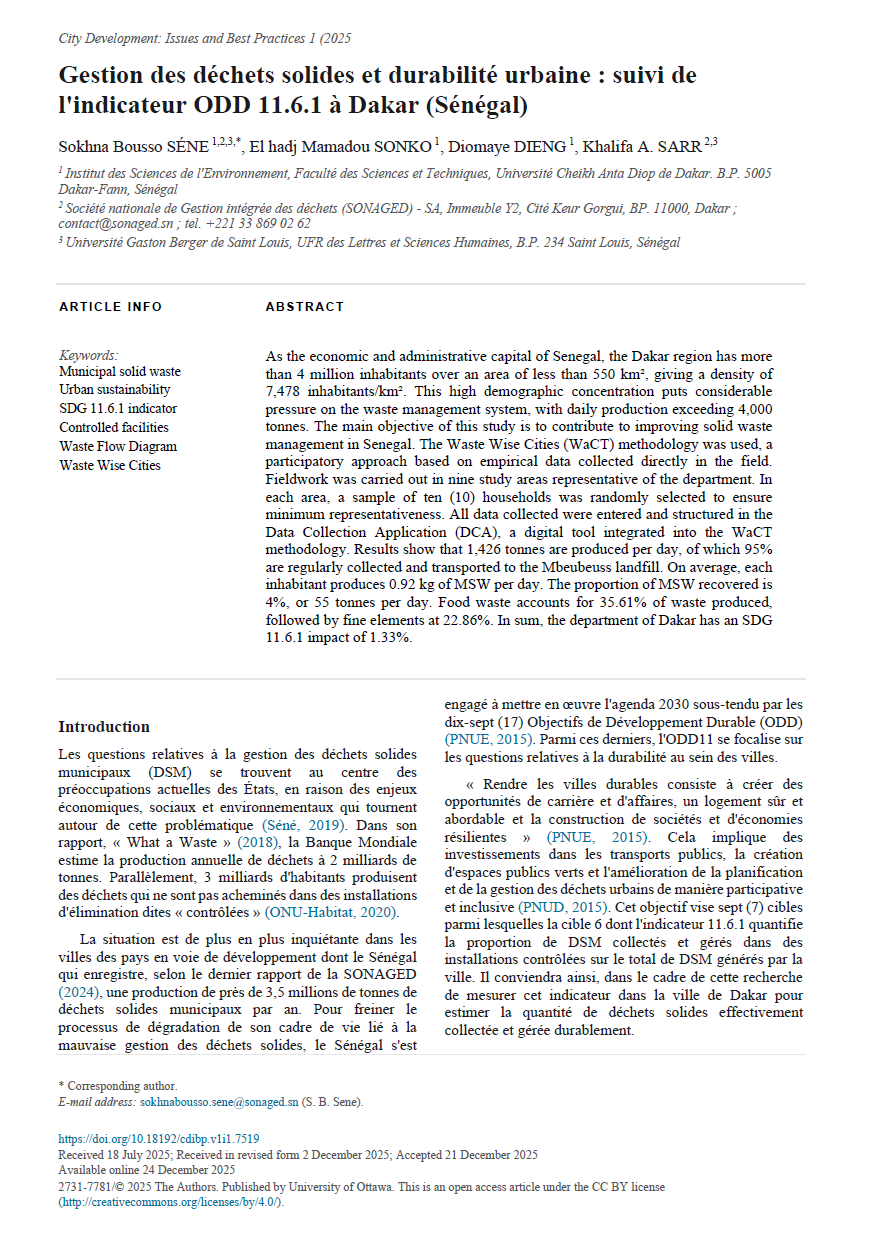
Senegal, and more particularly the city of Dakar, is currently facing major challenges in the management of municipal solid waste. With more than 2.4 million tonnes of waste sent to landfills annually at the national level—approximately 4,000 tonnes per day for the capital alone—the pressure on the waste management system is considerable. Dakar, a densely populated city undergoing rapid urban expansion, faces cumulative difficulties related to waste collection, recovery, and disposal. These limitations are further exacerbated by the heavy reliance on the uncontrolled landfill of Mbeubeuss.
As part of an assessment of the sustainability of the waste management system, the main objective of this study is to estimate the value of SDG indicator 11.6.1, which measures the proportion of waste collected and managed in controlled facilities in the city of Dakar. To achieve this, the Waste Wise Cities Tool (WaCT) methodology developed by UN-Habitat was applied. This standardized approach is based on seven steps that provide a reliable and comprehensive overview of the system. Data were collected in nine survey zones representative of three socio-economic levels—high, medium, and low—with ten households monitored in each zone. Over eight consecutive days, waste was weighed and characterized, providing an accurate picture of its composition and flows.
In addition, sampling was conducted in various non-household facilities, including hotels, restaurants, schools, offices, a market, and a hospital, in order to better capture their contribution to total waste generation. All data were entered into the Data Collection Application (DCA), which enables automatic compilation and the production of tables, graphs, and summary sheets.
The results indicate that total municipal solid waste generation in the department is estimated at 1,426 tonnes per day, of which 856 tonnes originate from households and 570 tonnes from non-household establishments. This corresponds to an average generation rate of nearly 0.97 kg of waste per capita per day. Waste generation varies significantly according to income level.
Waste composition analysis shows that the organic (food) fraction is by far the most dominant, accounting for 35.61% of the total, or 0.35 kg per capita per day. Fine materials, such as sand and dust, represent 22.86% and are particularly prevalent in informal settlements, where unpaved surfaces contaminate waste streams.
In terms of operational performance, waste collection reaches a high level, with 95.22% of generated waste (1,327 tonnes per day) effectively collected. However, 4.78% of waste escapes the collection system. Waste recovery remains marginal: only 4% of generated waste, equivalent to 55 tonnes per day, is recovered and valorized. Meanwhile, approximately 1,303 tonnes per day are transported to the Mbeubeuss landfill, which is classified as an uncontrolled facility due to the lack of waste covering, absence of leachate management, lack of access control, and other structural deficiencies.
As a result, the SDG indicator 11.6.1 calculated using the WaCT methodology reaches only 1.33%. This means that an extremely small proportion of municipal solid waste generated in Dakar is managed in facilities that meet minimum sustainability criteria. The near-total dependence on the Mbeubeuss landfill, combined with the near absence of controlled treatment or recovery infrastructure, largely explains this outcome.
Beyond the numerical results, the analysis highlights significant structural challenges. The high volumes of fine materials in low-income neighborhoods reveal deficits in urban infrastructure, such as unpaved roads and illegal dumping sites, which increase contamination and complicate recycling efforts. Paradoxically, despite a collection rate higher than that of many other African cities, Dakar records a very low SDG 11.6.1 score due to the lack of sustainable treatment stages. This situation exposes populations to health risks ranging from respiratory diseases and infections to injuries, particularly among informal waste pickers. Environmental impacts are equally concerning, including air, water, and soil pollution.
In conclusion, the analysis demonstrates that municipal solid waste management in Dakar does not meet international sustainability standards. Despite strong performance in waste collection, the lack of controlled infrastructure and low levels of waste recovery severely limit progress toward sustainable development. The study recommends extending research to other cities, incorporating a diachronic perspective to observe changes in practices over time, and further examining the institutional and social factors influencing sector performance.
Downloads
Published
Issue
Section
License
Copyright (c) 2025 City Development: Issues and Best Practices

This work is licensed under a Creative Commons Attribution-NonCommercial-NoDerivatives 4.0 International License.
License Terms for "City Development: Issues and Best Practices" Journal
By submitting an article to the "City Development: Issues and Best Practices" journal, authors agree to the following terms:
-
Authors' Rights: Authors retain the copyright to their work and grant the journal the right of first publication with the work simultaneously licensed under a Creative Commons Attribution License (CC BY 4.0) that allows others to share and adapt the work with an acknowledgment of the work's authorship and initial publication in this journal.
-
Open Access Policy: Authors permit their articles to be freely available immediately upon publication. This ensures that your work reaches the widest possible audience and can be read and cited by researchers worldwide.
-
Archiving and Preservation: Authors grant the journal the right to preserve and keep their work available in an archival form. This includes archiving in national and international databases, repositories, and indexing services.
-
Warranties: The author warrants that the submitted work is original, has not been published before (unless as part of a thesis or lecture notes), and is not currently under consideration for publication elsewhere.
-
Re-use and Distribution: Authors are permitted to post their work online (e.g., in institutional repositories or on their website) before and after the publication process, as it can lead to productive exchanges, as well as earlier and greater citation of published work.
-
Author's Acceptance: Upon acceptance of an article, authors will be asked to complete a 'Journal Publishing Agreement'.
Please note that these terms reflect the journal's commitment to promoting the dissemination of knowledge and information as widely as possible while respecting authors' rights. If you have any queries about our licensing terms or the submission process, please contact us.
