
Current Issue
Editorial Introduction – Second Issue
City Development: Issues and Best Practices (CDIBP)
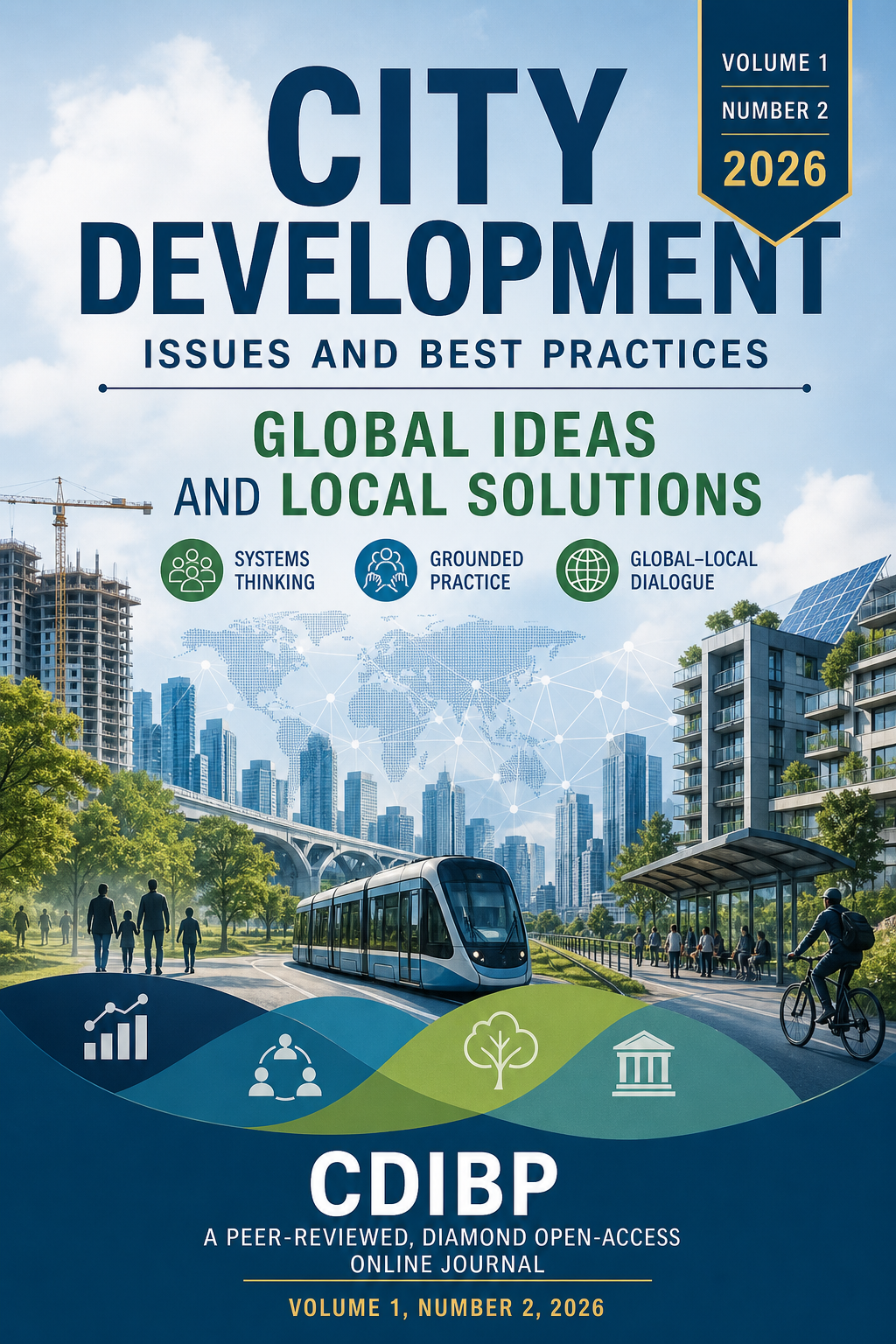
This second issue of City Development: Issues and Best Practices (CDIBP) consolidates the journal’s ambition to position urban research at the intersection of systems thinking, grounded practice, and global–local dialogue. Building on the inaugural issue, it advances a more integrated reading of contemporary urban challenges, moving beyond sectoral analysis toward a relational understanding of cities as complex, multi-scalar systems.
Across contributions spanning Canada, China, Tunisia, and Kenya, a common thread emerges: urban challenges—whether housing affordability, climate vulnerability, or infrastructure stress—are increasingly systemic, yet their resolution remains contingent on context-specific institutional, social, and spatial conditions. The strength of this issue lies not only in the diversity of cases, but in how these contributions collectively illuminate the interplay between structure, agency, knowledge, and implementation.
Reframing Urban Systems: From Structure to Agency
At the structural level, Gianni re-examines housing through a comparative lens, positioning Canada and China not as opposing models, but as distinct configurations of a shared tension between supply, affordability, and governance capacity. This perspective challenges simplified policy transfer and calls for a deeper understanding of housing as an institutional system shaped by long-term regulatory, demographic, and financial dynamics.
Shifting from structure to agency, Enns et al. document how youth in Mathare, Nairobi, responded to climate-related disasters through embedded social networks, local knowledge, and community leadership. Their contribution shows that resilience is not merely delivered through formal systems but actively produced through situated practices that often operate beyond institutional visibility.
Knowledge, Translation, and Practice
A related tension is addressed by Moghaddam et al., who examine the rapid expansion of artificial intelligence in urban research while identifying a persistent gap between technical development and decision-making relevance. The dominance of predictive approaches and the limited integration of sustainability and equity suggest that advances in computational capacity do not automatically translate into meaningful urban interventions.
This challenge is approached from a complementary angle in Achour-Younsi et al., where project-based learning is positioned as a bridge between knowledge and practice. By situating design education within real eco-district contexts, their work demonstrates how analytical, environmental, and social dimensions can be integrated in ways that are both measurable and transferable.
Intersections in Urban Practice
These structural, social, and epistemic dimensions converge most visibly in infrastructure and service delivery. Shileche’s analysis of public transportation in Nairobi illustrates how historical legacies, regulatory fragmentation, and rapid urban growth intersect to produce contemporary mobility challenges. Infrastructure thus appears not simply as a technical system, but as a site where governance choices, institutional constraints, and everyday practices become materially entangled.
Read together, the contributions suggest that urban challenges cannot be addressed through isolated interventions or single-sector perspectives. Housing systems shape access and inequality but are continuously reinterpreted through community practices; technological innovations expand analytical capacity yet remain limited without institutional integration; pedagogical approaches open pathways for translation, while implementation reveals the constraints of real-world contexts. Urban development thus emerges as an ongoing process of alignment—partial, negotiated, and context-dependent—between structural conditions, social actors, knowledge systems, and practical interventions.
Looking Forward
This second issue reinforces CDIBP’s role as a platform for analytical integration and practice-oriented scholarship. By connecting comparative analysis, community-based research, technological reflection, and pedagogical innovation, it contributes to a more actionable understanding of urban transformation.
We extend our sincere thanks to all authors and reviewers for their contributions, and to the ICCCASU community for its continued engagement in advancing a globally connected and practice-driven urban agenda.
Editorial team
Editor in Chief: Dr. Huhua Cao
Editor (English): Dr. Kh Md Nahiduzzaman
Editor (French): Dr. Olivier Dehoorne
Publication Manager: Dr. Lefranc Joseph
Full-Length Article
Welcome to the City Development: Issues and Best Practices Journal
Welcome to the City Development: Issues and Best Practices Journal. Here we are dedicated to fostering a deeper understanding of urbanization's challenges and opportunities in our rapidly evolving world. We believe that to foster sustainable and inclusive growth, we must embrace knowledge from diverse experiences and perspectives.
Our Mission
Our mission is to provide a rigorous and influential platform for academic research, case studies, and applied research addressing the most pressing issues in urban development. We are particularly interested in the lessons we can learn from the developing world, yet we also value insights from developed nations. We aim to bridge the gap between academia and policy-making, thus helping cities across the globe to grow more sustainably and inclusively.
What We Offer
This journal encompasses a broad range of topics, including urban equity and inclusivity, reforming informal settlements, climate change adaptation, urban risk management, privacy and security, urban resilience, participatory policy, and more. We offer our readers access to cutting-edge research and best practices, and a platform to share and discuss their own ideas and experiences.
Who We Serve
The City Development: Issues and Best Practices Journal serves a diverse audience, including geographers, planners, engineers, urban designers, architects, political scientists, sociologists, economists, and policy makers. Whether you're an academic looking for the latest research, a professional seeking practical insights, or a student exploring the field, you'll find valuable resources and a vibrant community here.
How to Get Involved
We invite scholars and practitioners to submit their research and case studies. Our editorial team, backed by a rigorous peer-review process, ensures that every piece we publish meets the highest standards of academic excellence and practical relevance.
Join us in this journey towards understanding and shaping the cities of the future. We look forward to your participation and contribution in this quest for knowledge and sustainable urban development. Welcome aboard!
