
A Pilot Randomized Controlled Trial of Anatomy Coloring Books for First-Year Medical Students: Impact on Anxiety and Anatomical Knowledge Retention
DOI:
https://doi.org/10.18192/uojm.v15i2.7422Keywords:
Anatomy, Education, colouring book, Medical education, StressAbstract
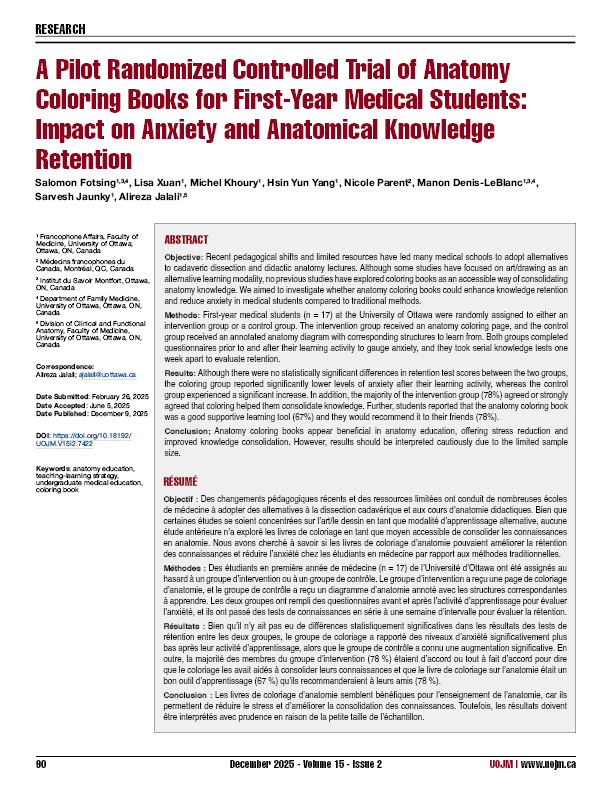
Objective: Recent pedagogical shifts and limited resources have led many medical schools to adopt alternatives to cadaveric dissection and didactic anatomy lectures. Although some studies have focused on art/drawing as an alternative learning modality, no previous studies have explored coloring books as an accessible way of consolidating anatomy knowledge. We aimed to investigate whether anatomy coloring books could enhance knowledge retention and reduce anxiety in medical students compared to traditional methods.
Methods: First-year medical students (n = 17) at the University of Ottawa were randomly assigned to either an intervention group or a control group. The intervention group received an anatomy coloring page, and the control group received an annotated anatomy diagram with corresponding structures to learn from. Both groups completed questionnaires prior to and after their learning activity to gauge anxiety, and they took serial knowledge tests one week apart to evaluate retention.
Results: Although there were no statistically significant differences in retention test scores between the two groups, the coloring group reported significantly lower levels of anxiety after their learning activity, whereas the control group experienced a significant increase. In addition, the majority of the intervention group (78%) agreed or strongly agreed that coloring helped them consolidate knowledge. Further, students reported that the anatomy coloring book was a good supportive learning tool (67%) and they would recommend it to their friends (78%).
Conclusion; Anatomy coloring books appear beneficial in anatomy education, offering stress reduction and improved knowledge consolidation. However, results should be interpreted cautiously due to the limited sample size.
----------
Objectif : Des changements pédagogiques récents et des ressources limitées ont conduit de nombreuses écoles de médecine à adopter des alternatives à la dissection cadavérique et aux cours d’anatomie didactiques. Bien que certaines études se soient concentrées sur l’art/le dessin en tant que modalité d’apprentissage alternative, aucune étude antérieure n’a exploré les livres de coloriage en tant que moyen accessible de consolider les connaissances en anatomie. Nous avons cherché à savoir si les livres de coloriage d’anatomie pouvaient améliorer la rétention des connaissances et réduire l’anxiété chez les étudiants en médecine par rapport aux méthodes traditionnelles.
Méthodes : Des étudiants en première année de médecine (n = 17) de l’Université d’Ottawa ont été assignés au hasard à un groupe d’intervention ou à un groupe de contrôle. Le groupe d’intervention a reçu une page de coloriage d’anatomie, et le groupe de contrôle a reçu un diagramme d’anatomie annoté avec les structures correspondantes à apprendre. Les deux groupes ont rempli des questionnaires avant et après l’activité d’apprentissage pour évaluer l’anxiété, et ils ont passé des tests de connaissances en série à une semaine d’intervalle pour évaluer la rétention.
Résultats : Bien qu’il n’y ait pas eu de différences statistiquement significatives dans les résultats des tests de rétention entre les deux groupes, le groupe de coloriage a rapporté des niveaux d’anxiété significativement plus bas après leur activité d’apprentissage, alors que le groupe de contrôle a connu une augmentation significative. En outre, la majorité des membres du groupe d’intervention (78 %) étaient d’accord ou tout à fait d’accord pour dire que le coloriage les avait aidés à consolider leurs connaissances et que le livre de coloriage sur l’anatomie était un bon outil d’apprentissage (67 %) qu’ils recommanderaient à leurs amis (78 %).
Conclusion : Les livres de coloriage d’anatomie semblent bénéfiques pour l’enseignement de l’anatomie, car ils permettent de réduire le stress et d’améliorer la consolidation des connaissances. Toutefois, les résultats doivent être interprétés avec prudence en raison de la petite taille de l’échantillon.
References
Singh R, Yadav N, Pandey M, Jones DG. Is inadequate anatomical knowledge on the part of physicians hazardous for successful clinical practice? Surg Radiol Anat SRA. 2022 Jan;44(1):83–92.
Borrelli M, Leung B, Morgan M, Saxena S, Hunter A. Should drawing be incorporated into the teaching of anatomy? J Contemp Med Educ. 2018;6(2):34-48
Singh V, Kharb P. A paradigm shift from teaching to learning gross anatomy: meta-analysis of implications for instructional methods. J Anat Soc India. 2013 Jun;62(1):84-9
Noorafshan A, Hoseini L, Amini M, Dehghani MR, Kojuri J, Bazrafkan L. Simultaneous anatomical sketching as learning by doing method of teaching human anatomy. J Educ Health Promot. 2014 May 5;3:50.
Estai M, Bunt S. Best teaching practices in anatomy education: A critical review. Ann Anat-Anat Anz. 2016 Nov;208:151–7.
McLachlan JC, Bligh J, Bradley P, Searle J. Teaching anatomy without cadavers. Med Educ. 2004 Apr;38(4):418–24.
Kerby J, Shukur ZN, Shalhoub J. The relationships between learning outcomes and methods of teaching anatomy as perceived by medical students. Clin Anat. 2011 May;24(4):489-97.
Joewono M, Karmaya INM, Wirata G, Widianti IGA, Wardana ING. Drawing method can improve musculoskeletal anatomy comprehension in medical faculty student. Anat Cell Biol. 2018 Mar;51(1):14–8.
O’Byrne PJ, Patry A, Carnegie JA. The development of interactive online learning tools for the study of Anatomy. Med Teach. 2008 Jan;30(8):260–71.
Alhamdani FY, Hatem HA. Drawings as learning aid for the human anatomy students’ based evaluation. J Oral Health Craniofacial Sci. 2017 Oct;2(4):090–5.
Alsaid B, Bertrand M. Students’ memorization of anatomy, influence of drawing. Morphologie. 2016 Mar;100(328):2-6.
Lefroy H, Burdon-Bailey V, Bhangu A, Abrahams P. A novel technique for teaching the brachial plexus. Clin Teach. 2011 Sep;8(3):196-9.
Kharb P, Samanta PP, Jindal M, Singh V. The learning styles and the preferred teaching-learning strategies of first year medical students. J Clin Diagn Res. 2013 Jun;7(6):1089-92.
Dempsey BC, Betz BJ. Biological drawing: A scientific tool for learning. Am Biol Teach. 2001 Apr;63(4):271-9.
McConnell J. The anatomy coloring book. British Medical Journal Publishing Group; 2012 Nov .
Dzulkifli MA, Mustafar MF. The influence of colour on memory performance: a review. Malays J Med Sci. 2013 Mar;20(2):3-9.
Beers GW, Bowden S. The effect of teaching method on long-term knowledge retention. J Nurs Educ. 2005 Nov;44(11):511-4.
McMenamin PG. Body painting as a tool in clinical anatomy teaching. Anat Sci Educ. 2008 Jul-Aug;1(4):139-44.
Dyrbye LN, West CP, Satele D, Boone S, Tan L, Sloan J, Shanafelt TD. Burnout among U.S. medical students, residents, and early career physicians relative to the general U.S. population. Acad Med. 2014 Mar;89(3):443-51.
Hill MR, Goicochea S, Merlo LJ. In their own words: stressors facing medical students in the millennial generation. Med Educ Online. 2018 Dec;23(1):1530558.
Schulz KF, Altman DG, Moher D; CONSORT Group. CONSORT 2010 statement: updated guidelines for reporting parallel group randomised trials. BMJ. 2010 Mar 23;340:c332.
Spielberger CD. State-trait anxiety inventory for adults. Palo Alto, CA: Mind Garden; 1983.
Netter FH. Netter Atlas of Human Anatomy: Classic Regional Anatomy Approach. In: ClinicalKey. 8th ed. Elsevier; 2022.
Ramanaiah NV, Franzen M, Schill T. A psychometric study of the State-Trait Anxiety Inventory. J Pers Assess. 1983 Oct;47(5):531-5.
Eaton J, Tieber C. The Effects of Coloring on Anxiety, Mood, and Perseverance. Art Ther. 2017 Jan;34(1):42-6.
Clavert P, Bouchaïb J, Duparc F, Kahn JL. A plea for the use of drawing in human anatomy teaching. Surg Radiol Anat. 2012 Oct;34(8):787-9.
Segawa H, Araki N, Miki A, et al. Creation of Stereo-paired Color Vascular Anatomical Charts Using 3-dimentional Images. Nihon Hoshasen Gijutsu Gakkai Zasshi. 2022 Jan ;78(1):62-71.
Downloads
Additional Files
Published
How to Cite
Issue
Section
License
Copyright (c) 2025 Salomon Fotsing, Lisa Xuan, Michel Khoury, Hsin Yun Yang, Manon Denis-LeBlanc, Sarvesh Jaunky, Alireza Jalali

This work is licensed under a Creative Commons Attribution-NonCommercial-NoDerivatives 4.0 International License.
- Authors publishing in the UOJM retain copyright of their articles, including all the drafts and the final published version in the journal.
- While UOJM does not retain any rights to the articles submitted, by agreeing to publish in UOJM, authors are granting the journal right of first publication and distribution rights of their articles.
- Authors are free to submit their works to other publications, including journals, institutional repositories or books, with an acknowledgment of its initial publication in UOJM.
- Copies of UOJM are distributed both in print and online, and all materials will be publicly available online. The journal holds no legal responsibility as to how these materials will be used by the public.
- Please ensure that all authors, co-authors and investigators have read and agree to these terms.
- Works are licensed under a Creative Commons Attribution-NonCommercial-NoDerivatives 4.0 International License.
